



A company may run a successful innovation trial yet fail to repeat the result when the sponsor leaves or funding changes. ISO 56001 addresses the management system behind innovation. This article explains how employee ideas connect to company objectives, time and funding, then putting a solution into daily work and reviewing its results, so that a promising trial becomes part of an organizational capability rather than an isolated success.
An idea is a starting point
An Innovation Management System organizes how innovation activities are directed, managed and reviewed. ISO 56001:2024 provides requirements for such a system and applies to organizations of different sizes and activities. [1] An idea is a possibility to develop and test. It may ultimately be changed or stopped.
Being new to a team does not automatically make an idea useful to customers. Innovation may concern a service, a process or a way of delivering value, without inventing a new device. Begin with a specific question: which problem should be solved, for whom, and what would change if the solution worked?
Give innovation a place in management decisions
Leadership needs to explain which kinds of value the organization seeks and where innovation effort belongs. That direction must connect to resources and review. A strategy can name priority opportunities; the management system makes responsibility for pursuing and reassessing them part of ordinary management work.
For example, a company may seek easier access to a service while preserving accuracy. The manager supporting the initiative and securing its resources identifies the boundary, makes employee time available and sets a review point. The team should know who can approve spending, resolve conflicts with daily work and accept a solution into operation. The exact roles and review frequency are organizational choices, not a timetable imposed by this article.
Manage initiatives together, not as isolated suggestions
An innovation portfolio is the set of initiatives an organization manages together. A shared list shows which are exploring a problem, testing a solution or preparing for everyday use. These stages are a suggested working arrangement. Their purpose is to reveal competition for the same people, technology or customer access. Approving every proposal separately can commit the same capacity several times.
Review resources alongside uncertainty and intended value. A team should explain what it needs to learn before more time or money is committed to the initiative. Preserve the reasons for stopping or deferring work so that another team does not repeat it unknowingly. This makes the link between idea selection, funding and organizational learning visible; it does not mean that every idea must reach implementation.
Hypothetical example: complete service requests
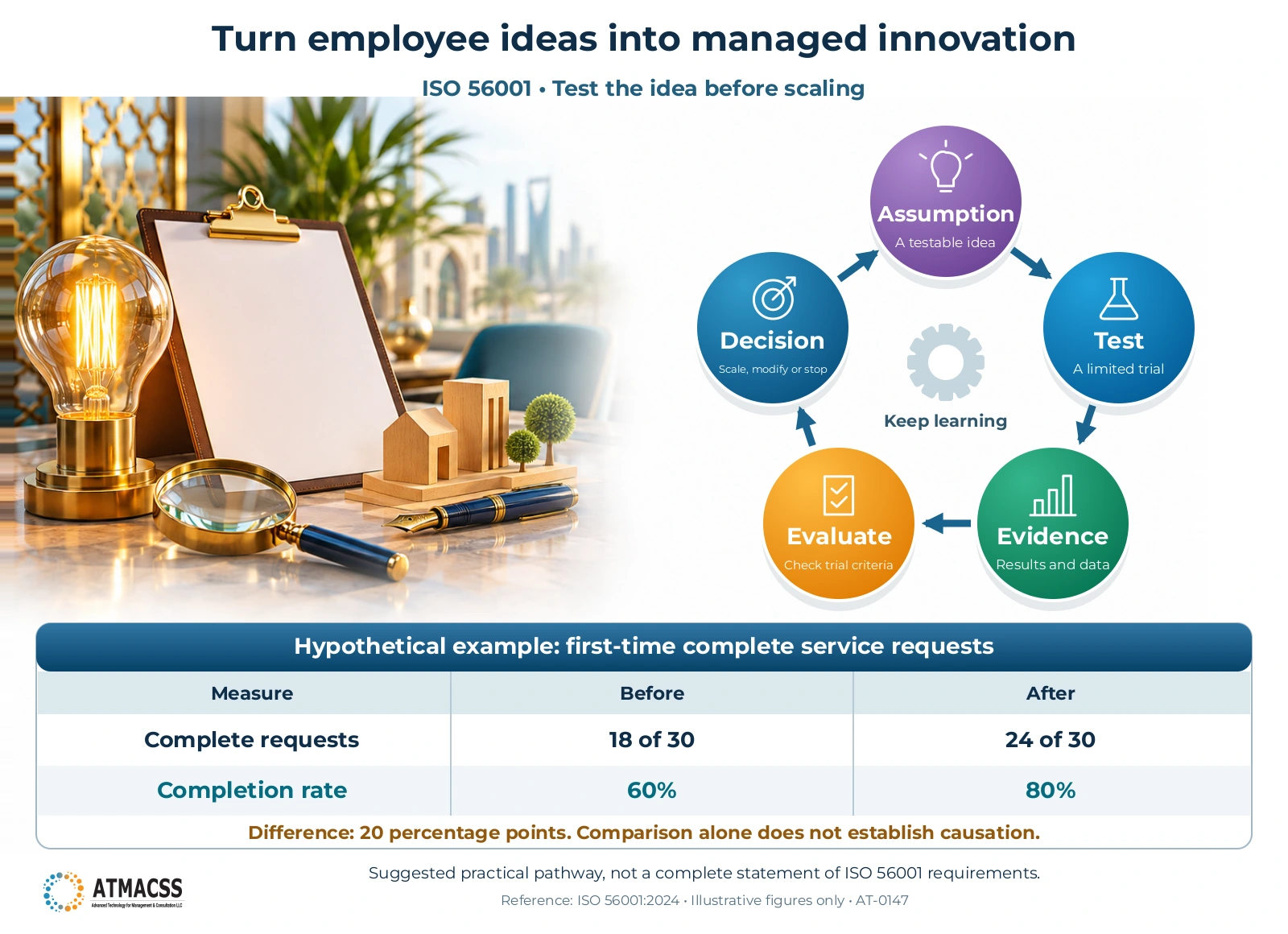
A service company proposes that a short document checklist will reduce incomplete submissions. It tests a revised version on 30 requests during a defined period. Of these, 24 are complete on the first attempt, giving 80%. The hypothetical baseline is 18 complete requests out of 30, or 60%.
The difference is 20 percentage points, rather than a 20% increase. The relative increase is approximately 33.3%. However, this small comparison does not prove that the checklist caused the difference. Examine customer mix, request types and timing, and repeat the test before expanding it. The company also monitors staff time and complaints, so that one measure does not improve at another's expense.
Plan everyday use before declaring success
The checklist trial above produces evidence for a decision, not proof that the organization can sustain the result. If further testing supports using the solution, assign someone to run and monitor it, approve the working version and prepare the affected team. Agree how customers receive the checklist, how exceptions are handled and who maintains it when requirements change.
A useful handover records the service boundary, remaining uncertainties, support needs and measures to review after use. This is a suggested arrangement, not a compulsory form. If the trial team disappears and nobody maintains the solution, the institution has not secured a repeatable capability. Funding a pilot and funding continued delivery are different commitments.
Evaluate the system as well as each initiative
An initiative review asks whether a particular solution is worth continuing. System evaluation asks whether the organization can repeatedly identify opportunities, provide resources, learn and realize value. These are different questions. A high idea count may coexist with slow decisions, unavailable staff or solutions that never enter use.
Use evidence from several initiatives, internal audits and management review to locate recurring barriers. If projects repeatedly stall during handover, check who takes responsibility for the solution after the trial and whether they have the time, staff and funding needed rather than asking employees for more ideas. Management can change those arrangements and check whether subsequent handovers improve. Explain unsuccessful experiments honestly; a justified stop can prevent waste, while repeated avoidable failures can reveal a system weakness.
Integrate the system without building a second bureaucracy
ISO 56001:2024 provides requirements and guidance for establishing, implementing, maintaining and improving an innovation management system. Its structure, shared with other management system standards, helps combine activities such as audits and management review instead of duplicating them unnecessarily. [1] Existing document control, competence, audit and management review arrangements can support that work when their scope and methods fit innovation needs.
Start by tracing one employee idea through responsibility, resources, experiment, adoption and later review. Then check whether the same arrangements work across other initiatives. Compare the system with the complete official standard before claiming conformity. Neither this pathway nor a successful experiment establishes certification or guarantees a commercial result.
Our ISO implementation and certification-readiness service explains support for gap assessment, implementation and readiness review.