



A company may know its obligations yet struggle when a requirement changes or the employee tracking it is absent. The challenge is turning knowledge into traceable action. This article explains how compliance management connects obligations, owners, controls and evidence, and how to review effectiveness without reducing compliance to a list of laws or a certificate on the wall.
What is a compliance management system?
A Compliance Management System, or CMS, organizes how an organization manages its obligations and checks that they are fulfilled. ISO 37301:2021 addresses this system. Its scope is broader than the anti-bribery focus of ISO 37001. The official catalogue also lists a climate amendment issued in 2024. [1] [2]
An obligation is something the organization must meet or has chosen to commit to within its context. A control is an action supporting fulfilment. Evidence demonstrates what happened and its result. Confusing these concepts makes a written policy appear sufficient, even when nobody follows it.
Start with what applies to the activity
The editorial team suggests first identifying the companies or other legal entities covered by the work, their locations, activities and contracts, then identifying applicable sources of obligations. These may include licence conditions, contracts, regulatory requirements and adopted commitments. Do not simply copy another company's list. Country, activity, information and involved parties may differ.
For operations across the Gulf, connect each obligation to the entity and activity it concerns. Record its source, version and review date. Refer consequential interpretation questions to an appropriate legal or regulatory specialist. This article explains a management approach. It does not provide a complete legal inventory for any country.
Turn the inventory into everyday work
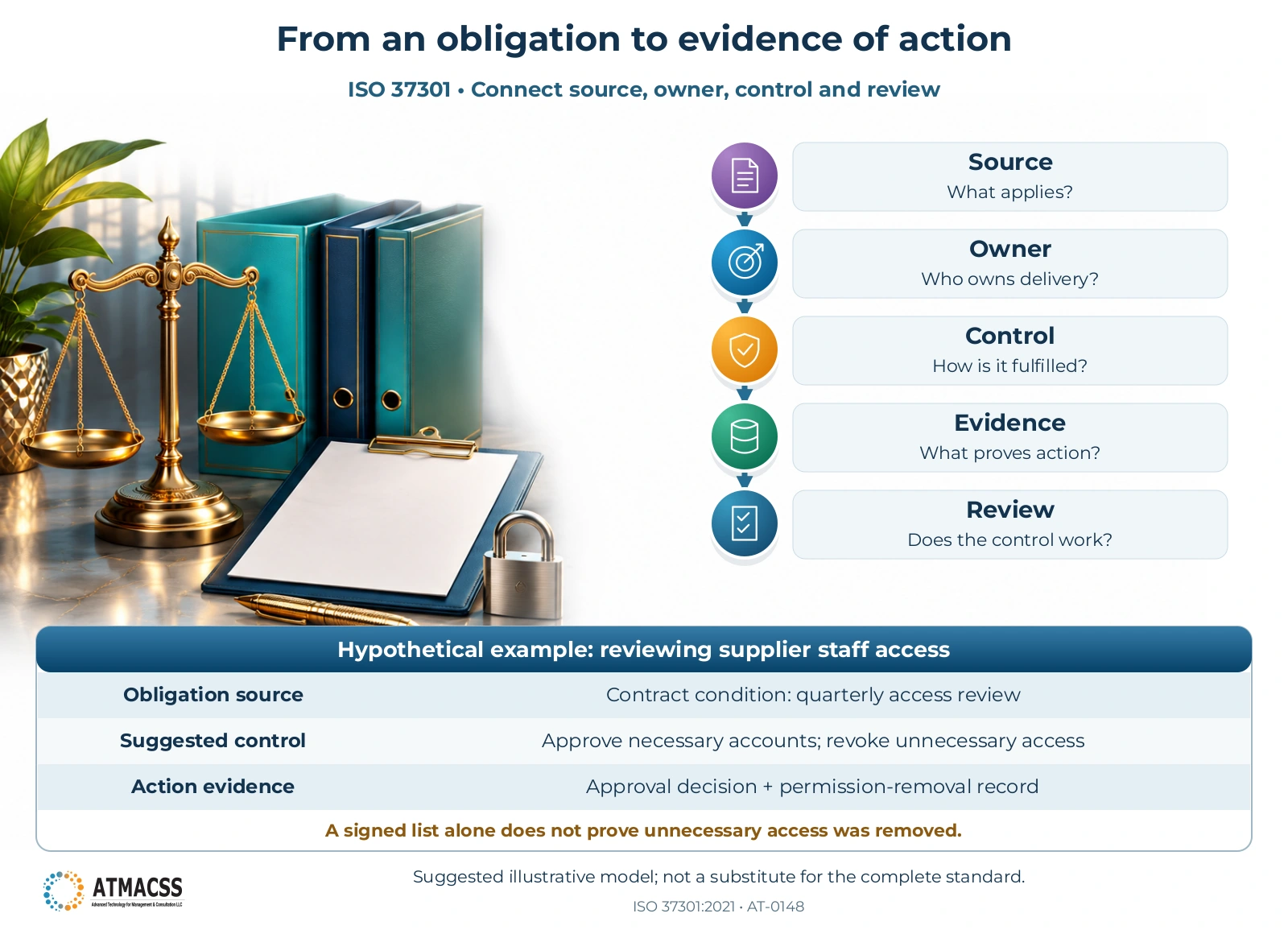
An obligations register is a practical organizing tool, not the purpose of the system. It can record the obligation, source, owner, action, evidence and review date. Entering “management” as the owner is insufficient. Identify the role able to act or refer the problem to someone with the authority to resolve it when action cannot be completed.
A control might involve a review before signature, restricted access or a reminder followed by verification. Select it according to the likelihood and consequences of failure, then ask how failure would be detected. Numerous controls are not necessarily robust when they all depend on one person or outdated information.
Hypothetical example: a supplier contract
Assume that a contract requires quarterly review of supplier staff access. This is a condition of the example, not a general legal rule. The person responsible for managing the contract records which systems and data the supplier’s staff may access. The system administrator prepares the account list. The person responsible for the workflow approves continued access or removal for each account.
Suggested evidence includes the reviewed list, approval decisions and records of removed permissions. Signing the list without removing an unnecessary account means the required action has not been fully carried out. Closing a calendar reminder is insufficient. Verify the change in the actual system, address the reasons for delay and review the outcome.
How can you assess effectiveness?
Select obligations and actions for checking according to the likelihood and consequences of failure, rather than choosing only files that look complete. Compare the obligation with actual work. Check who approved the action, when it happened and what changed. Ask the employee performing the work; their explanation may reveal instructions that do not cover real situations.
Possible measures include overdue obligation reviews, recurring problems and the time taken to address failures. These are suggested indicators, not standalone proof of compliance. Fewer reports might indicate improvement. They might also indicate that employees do not understand or trust the reporting route. Interpret figures alongside evidence and context.
Responding to failures and change
Define a route for receiving and examining concerns, with appropriate confidentiality, named reviewers, routes for referring issues to higher authority, and applicable protection for people reporting concerns. Do not promise absolute secrecy that cannot be delivered. Avoid making the person responsible for a problem its sole reviewer. Responses depend on the facts, applicable requirements and the rights of those involved.
When a contract, activity or regulatory requirement changes, review the associated obligations, controls, training and evidence. Correct the immediate situation, then examine why it occurred. Retraining everyone may not resolve a technical permission problem or a responsibility that was never assigned.
What are the limits of the system?
Document control, reviews and audits can be coordinated with other management systems, while keeping subject-specific obligations visible. Integration means more than placing separate files in one folder. Its practical value appears when each person understands their responsibility and the evidence needed.
Certification does not provide immunity from violations or replace interpretation of applicable requirements. ISO itself does not issue certificates. [3] Begin with one important obligation and trace its source, owner, control, evidence and review. If an obligation has no responsible person, an action was not completed, or a result was not reviewed, address that before adding more entries to the register.
To connect these steps to a system that fits your operations, our ISO implementation and certification-readiness service explains the support available, from gap assessment to readiness review.