



When a standard changes, a company may update document numbers and headings while daily work remains unchanged. Gap analysis helps identify what has actually changed and what implementation needs to follow. This article explains a structured comparison between the revised reference and current practice, then shows how to turn differences into actions and verification evidence without rebuilding everything automatically.
Establish the reference before comparing
Gap analysis compares current arrangements with a defined reference to identify missing or different elements. First record the standard, edition, applicable amendments and document status. ISO distinguishes draft development from publication. A proposed standard should not be treated as a final published document. [1]
Reviewing a draft can support early preparation, but the findings remain provisional until checked against publication. A certification transition deadline requires a separate authoritative source from the body responsible for the certification programme’s rules or from the certification body. Do not assume a common period for every standard or infer it from marketing announcements.
Understand the change before editing files
Read the intended requirement, then compare it with the previous edition and actual practice. A clause number may change without a substantive change. A short new sentence may alter responsibilities or necessary evidence. Mapping clause numbers supports traceability, but cannot establish the operational effect by itself.
The editorial team suggests classifying differences as editorial changes, clarifications or new or amended requirements. This is a working aid, not a predetermined conclusion. Check each difference against the official text. Seek specialist interpretation where uncertainty could change the application scope.
What should be compared in practice?
The comparison needs both documentation and implementation evidence. Read the procedure, then examine appropriate work samples, records and interviews. A procedure may describe activities that do not happen. A team may also follow a useful practice whose responsibilities or evidence are insufficiently defined.
Describe the gap precisely: a missing activity, weak implementation, insufficient evidence or conflicting responsibilities. “Update the system” is not a useful corrective action. It does not tell the person responsible for the workflow what must change. State what the verification should demonstrate after the action is complete.
Create a table linking changed requirements to actual work
Use two connected comparisons. First map the old reference to the updated one and explain the substantive difference. Then compare that difference with actual practice. A renumbered clause may need only a reference update; a new obligation may require action even when the manual already uses similar words. Keep “no operational change needed” decisions with their reasons, rather than manufacturing work for every row.
The following worked record extends the climate example below. It illustrates a gap assessment for an applicable 2024 amendment, not a claim about the publication or transition date of another edition.
| Comparison field | Hypothetical entry |
|---|---|
| Reference change | Applicable 2024 climate amendment: determine whether climate change is relevant; consider relevant interested-party requirements. |
| Existing practice and evidence | Supplier review records delivery delays, but contains no evaluation of climate relevance. |
| Gap and consequence | The review cannot show whether climate-related disruption affects intended system outcomes. |
| Action and dependencies | Operations assesses how climate risks could affect the supplier and transport route; procurement checks affected requirements; management decides the response before related instructions are revised. |
| Owner and timing | Operations manager; assessment before the next supplier approval, followed by verification before closure. These are example choices. |
| Closure evidence | A recorded decision explaining whether climate change is relevant and why, evidence that any selected action was carried out, and a check using a real case or representative trial to confirm that the approach works. |
After issuing a revised instruction, mark the item implemented and awaiting verification. Close it only when the check supports closure. If the assessment finds climate change not relevant to the intended outcomes, retain a reasoned basis for that conclusion and review it when circumstances change. Do not invent an action merely to make every row look identical.
Hypothetical example: climate considerations
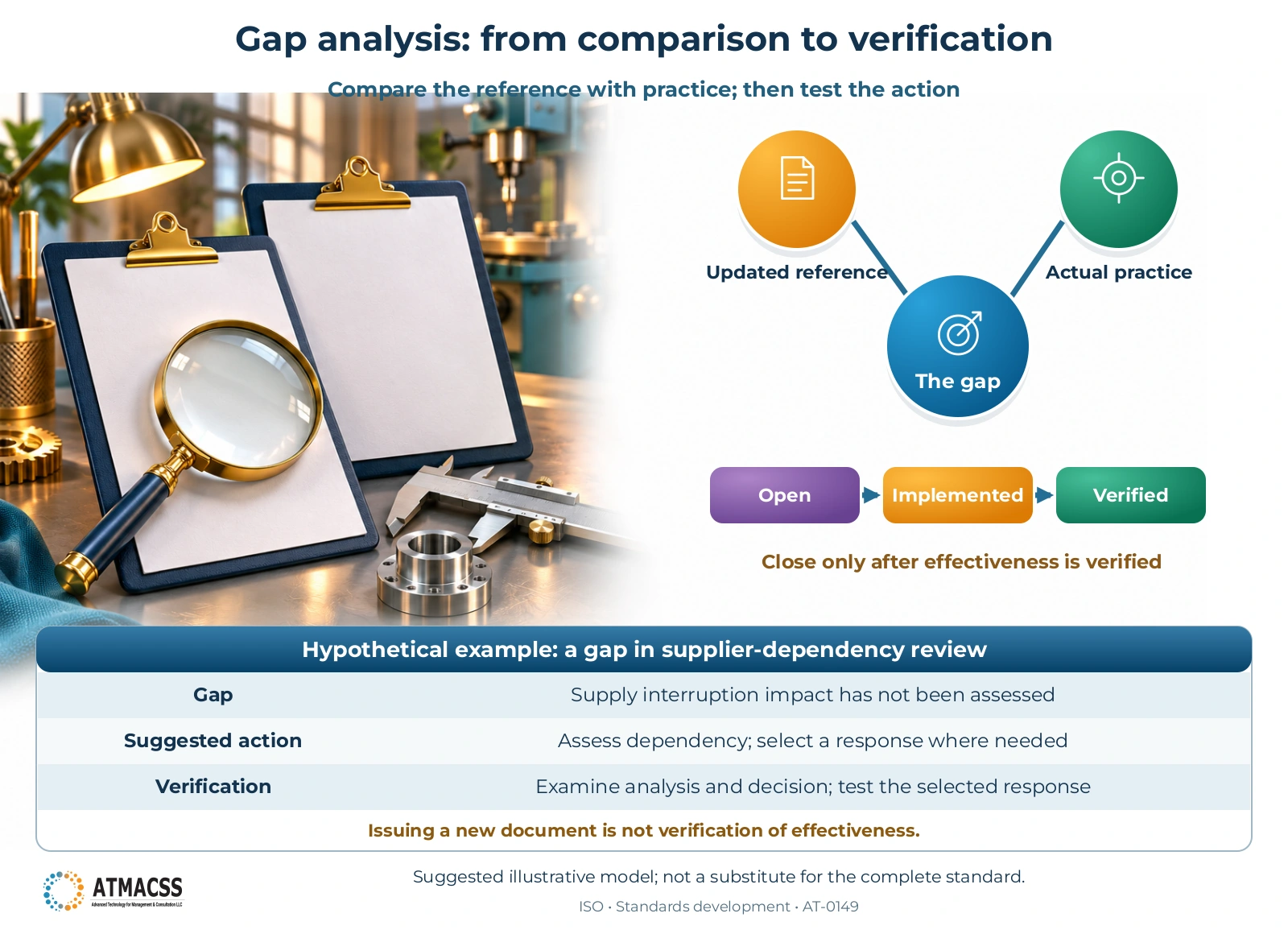
An organization reviews a system covered by the 2024 climate amendment. The amendment calls for determining whether climate change is relevant to system outcomes. It also highlights that interested parties may have climate-related requirements. [2] In this example, the organization has not examined supply interruption associated with climate risks.
The suggested action is to evaluate the supplier and transport dependency, determine relevance and consequences, then select a response where necessary. Evidence means more than adding “climate considered” to a document. It should support an understandable analysis, decision and implementation where action is selected. This is a suggested documentation approach, not a compulsory template imposed by the amendment.
When is a gap closed?
Distinguish completing an action from verifying its effectiveness. Issuing new instructions demonstrates publication, not that employees can apply them. Test an actual case or suitable simulation, examine the resulting record and decide whether the practice meets the intended requirement.
Use clear statuses such as open, implemented awaiting verification, and closed after verification. Do not combine the last two in management reporting. If a problem appears, reopen the item and explain what failed. Changing its label to protect a completion percentage does not resolve the gap.
Preserve what works and change what needs changing
Do not replace every document merely because an edition year changes. Retain practices that meet requirements and revise affected elements. Prevent use of superseded versions while retaining the earlier editions and change records that are needed. Check effects on contracts, software, forms and training, not only the management manual.
Start with one process and complete the comparison through verification before expanding the review. A useful analysis produces an executable plan and closure evidence. It does not rely on an unsupported conformity percentage. This article explains the method; it does not announce the publication or transition deadline of a particular standard.
To connect these steps to a system that fits your operations, our ISO implementation and certification-readiness service explains the support available, from gap assessment to readiness review.