



A company can approve an AI tool and still lack a system for managing its effects. The missing link is often between everyday use and decisions about risk, resources and improvement. This article explains how ISO/IEC 42001 connects those decisions across the organization, what an AI inventory cannot achieve alone, and how to judge whether a management system is actually working.
What does the standard govern?
An Artificial Intelligence Management System, or AIMS, organizes policies, responsibilities and processes for developing, providing or using AI. ISO/IEC 42001:2023 specifies requirements for this system. Its scope includes organizations using AI solutions, not only developers. [1]
In practical terms, buying a reliable tool does not answer every question about its use. The company needs to know where it enters the workflow and who approves its outputs. A management system governs activities within a defined scope. It does not certify that every answer produced by an application is correct.
From an inventory to a management system
An inventory answers “where do we use AI?” An Artificial Intelligence Management System connects that information to objectives, accountable decisions, risk treatment and performance review. ISO describes the framework as covering leadership, policy, planning, operational controls and improvement across the organization. [3]
Consider two departments using the same tool. Customer service checks replies, while sales lets it prepare quotations. Separate approvals may miss a shared problem: the tool uses outdated price information. The system needs a route for that discovery to reach both teams, the person responsible for keeping information accurate and current and whoever can change or suspend the use. Adding another inventory column will not, by itself, establish that route.
Connect scope, objectives and effects on people
Define which activities and dependencies the system covers, including suppliers and connected information sources. Then state the outcome management wants and how it will be assessed. “Use more AI” describes activity. A suggested objective might instead be reliable draft preparation with required review completed and errors addressed. Targets should follow a baseline and the consequences of failure.
Examine both risks to the organization and effects on people affected by its use. An inaccurate internal summary differs from an output an employee uses to decide whether a customer is entitled to a service or compensation. The company should understand who may be affected, how, and what response is appropriate. This is not a scoring formula supplied by this article. Assess the actual use and relevant obligations before choosing controls.
Make procurement and operations share responsibility
A practical division of work makes the person responsible for the workflow define the tool’s purpose, IT manage its system connections and access permissions, and specialists review matters in their fields. Procurement should obtain the supplier information needed to understand the service and its changes. Management resolves gaps in authority or resources. In a small company, roles may be combined, but records must show who made each decision and why.
Connect this work to existing purchasing, training, information security and change processes. For example, renewing a subscription should not silently approve a new integration that sends additional customer information to the supplier. Identify the change, reassess its effects and approve the appropriate controls before introducing it. The allocation described here is a practical suggestion, not a mandatory organization chart.
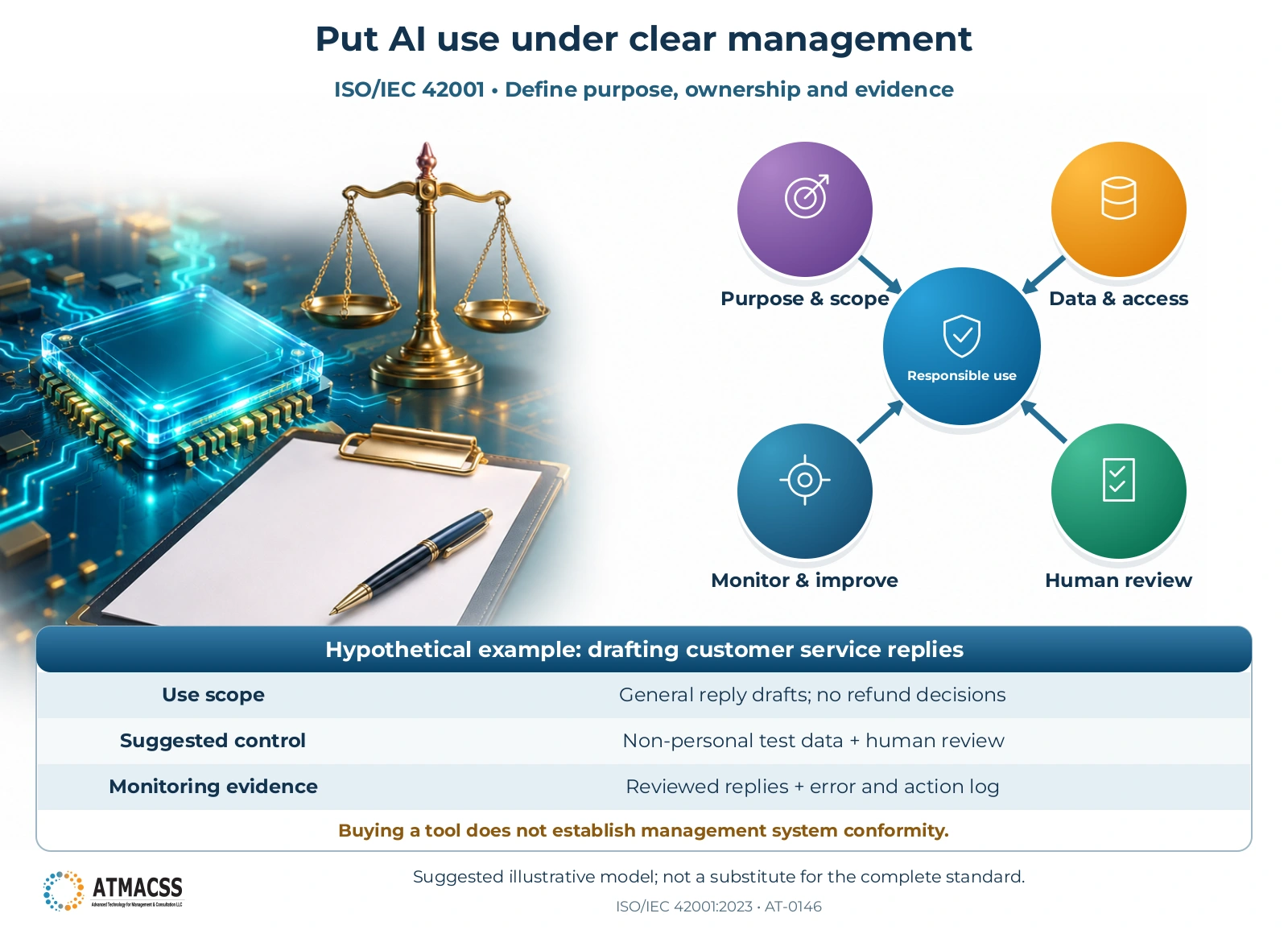
Hypothetical example: customer service drafts
A service company proposes using AI for general replies, while excluding refund decisions. It begins with test information containing no personal data. A service supervisor checks factual accuracy, use of approved information and the possibility of unauthorized promises.
An employee sends an approved reply under their professional responsibility. Repeated errors trigger stopping use of the tool for the task in which the error recurs and revision of its instructions or source information. Faster drafting alone does not demonstrate success. Less time spent writing may be offset by more time spent correcting the draft. The pilot therefore compares complete handling time and response quality, without assuming improvement in advance.
Turn operating evidence into management decisions
The example above tests a single use. At system level, management also needs to know whether responsibilities are clear, staff can perform their work, and supplier agreements and protective and monitoring procedures remain suitable across the defined scope. Combine evidence from operation with internal audit findings and management review. An audit asks whether arrangements meet requirements and work as intended; management review uses the findings to decide what needs to change.
Suppose repeated errors come from an outdated knowledge source. Correcting individual replies contains the immediate problem. Investigating why updates failed, assigning ownership and checking subsequent outputs addresses recurrence. Management may need to fund source maintenance or restrict the use until it is reliable. Record the decision and verify the result; closing a ticket is not the same as demonstrating improvement.
Decide on implementation before certification
An inventory, an approved-use policy and a successful pilot are useful inputs, but they do not establish complete conformity. Compare the defined system against the full official standard, identify where follow-up breaks down between detecting a problem, assessing it, addressing it and checking the result and test them through real work. The organization remains responsible for relevant legal and contractual obligations; the management system does not replace them.
Certification is a separate decision. External certification bodies issue certificates, not ISO. [2] Customer requirements may influence that decision. A useful next step is to follow one issue from detection through risk assessment, assigned action, management decision and verification. If the trail stops at a spreadsheet, strengthen the system before presenting it as complete.
Our ISO implementation and certification-readiness service explains support for gap assessment, implementation and readiness review.