



Orders increase, followed by hiring, rent and overtime. The company looks bigger, yet the amount left at month-end may barely improve. Scalability asks a practical question: can the business serve more customers while sharing some of its existing resources? The answer starts with order costs and how much work existing staff and equipment can deliver, referred to here as operating capacity, then addresses wasted effort before adding permanent commitments.
Growth alone is not enough
Scalability is a business model’s ability to handle greater volume efficiently while maintaining its service standard. It does not mean costs stay fixed forever. Some activities require more people or equipment as demand rises. Better work design can delay that step or make the additional resources more productive.
Imagine a service company in the UAE winning new contracts. If every employee rebuilds templates and reports from scratch, effort may rise almost alongside contract numbers. Approved templates, organised data and clear review stages can support additional clients without doubling administration. Client-specific professional work remains essential. The objective is to remove repetition while protecting quality.
Separate costs before deciding
Fixed costs, such as rent for an existing workspace, do not change with every order while the workload stays within the capacity of the current space and resources. Variable costs, such as materials and sales commission, move with volume. Some expenses contain both elements. The US Small Business Administration explains this distinction in its break-even resources [1].
Also consider costs that rise in steps. An existing team may support a certain workload before another supervisor or larger warehouse becomes necessary. Do not price an expansion using average costs from a quiet month if it exceeds current capacity. Ask operations when delays or overtime begin, and ask finance which new commitments that threshold would trigger.
An example: more sales and a lower unit cost
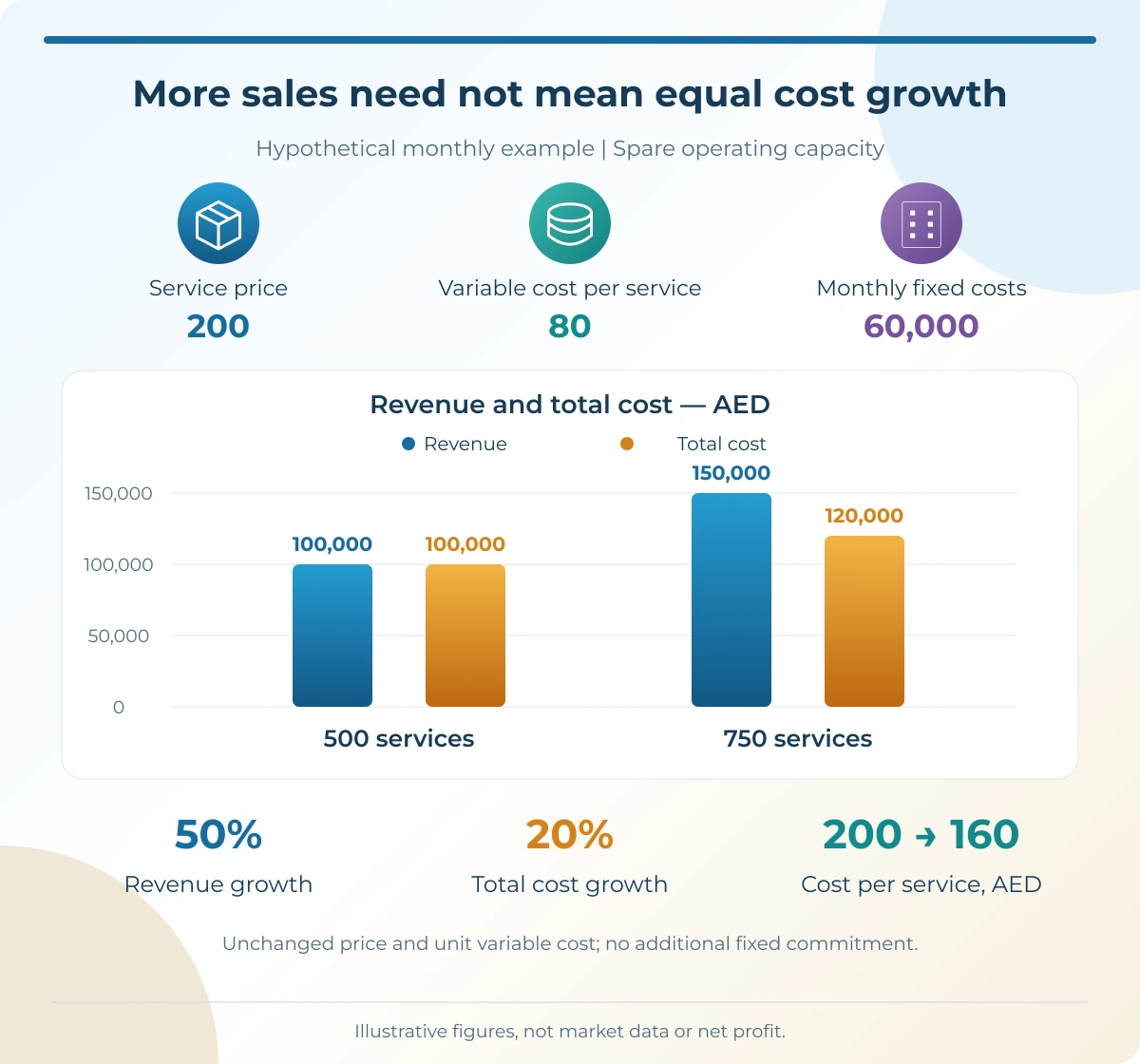
This is a hypothetical calculation, not a company result or a market benchmark. Assume a standard service sells for AED 200 and has a variable cost of AED 80. Monthly fixed costs are AED 60,000. Existing capacity can deliver 750 services at the required quality.
At 500 services, revenue is AED 100,000 and variable costs are AED 40,000. Total modelled costs reach AED 100,000, leaving a zero balance. At 750 services, revenue rises to AED 150,000 and variable costs reach AED 60,000. Total costs become AED 120,000, leaving AED 30,000 before any excluded items.
Revenue rises by 50%, while total costs rise by 20%. Average cost falls from AED 200 to AED 160 per service. The example assumes unchanged pricing, variable unit costs and sufficient capacity. It excludes financing, taxes and other items, so the balance is neither net profit nor cash collected. If the additional volume requires another fixed commitment, recalculate the result.
What happens when more work requires additional resources?
The previous diagram uses spare capacity: up to 750 services, fixed costs remain AED 60,000. Now extend the same hypothetical example. Suppose going beyond 750 requires an additional monthly commitment of AED 18,000, bringing fixed costs to AED 78,000. Price remains AED 200 and variable cost remains AED 80 per service.
At 800 services, total modelled costs are AED 142,000 and the balance is AED 18,000. Selling 50 more services than at 750 has reduced the balance by AED 12,000. Revenue from the additional services, less their variable costs, is only AED 6,000, while the new commitment costs AED 18,000.
| Monthly services | Fixed costs (AED) | Total costs (AED) | Balance (AED) |
|---|---|---|---|
| 750 | 60,000 | 120,000 | 30,000 |
| 800 | 78,000 | 142,000 | 18,000 |
| 900 | 78,000 | 150,000 | 30,000 |
To recover the previous AED 30,000 balance after the step, the business needs 900 services: (78,000 + 30,000) ÷ (200 − 80). This assumes the new capacity can deliver at least 900 at unchanged quality and variable cost. The figures exclude the same items as the earlier example. They help assess whether to increase the amount of work the company can deliver; they are not a profit forecast.
Ask whether removing repeated work could defer the commitment, or whether assigning a defined part of the work to a qualified provider is permitted and could cost less after all expenses are included. Compare the full costs and service risks. The earlier diagram remains valid within its stated capacity range; its falling unit cost must not be extrapolated beyond that range.
Protect cash and service during expansion
Sales may look profitable on paper while payment arrives late. If materials and salaries are paid before invoices are collected, growth can increase working capital needs: funds tied up in short-term operations. Review payment and collection timing alongside the capacity plan. A revenue forecast alone is insufficient. Avoid heavy discounts simply to fill spare capacity if they reduce the amount left after each order’s variable costs to an unsuitable level.
Track a small set of measures: the amount left after each order’s variable costs, delivery time, rework and available cash. Compare similar services over comparable periods. An overall average can hide a loss-making service supported by another. A team can also appear more productive because difficult jobs were postponed, rather than because the process improved.
When is expansion justified?
Before signing another lease or adding a team, write a one-page decision. Set out expected demand, existing capacity, the cost triggered by exceeding it, and funding before customers pay. Test a lower-demand case too. Decide which commitments you would postpone if the expected orders do not arrive.
Expansion is stronger when worthwhile business increases and the company can deliver without damaging service or creating an unaffordable cash gap. If every sales increase requires equal or greater spending, first review pricing, delivery methods, and the types of services sold and each type’s share of sales. A larger business is not automatically a better business. The useful outcome is valuable work that can be delivered consistently.
To connect this decision with your company’s direction, read Business Growth Strategy.