



A company needs new capabilities or customers and faces two options: build what it needs or acquire a business that already has it. Acquisition can look faster, while internal growth can seem less risky. Those impressions are insufficient. A useful comparison starts with the objective, then examines time, cost, cash and execution, including what happens after a deal closes.
Start with the capability you need
Organic growth develops and expands the company’s own operations, for example by training a team or launching a service. Acquisition involves purchasing shares, assets or an activity, depending on how the sale is arranged and what it includes, known as the transaction structure. What transfers to the buyer, and which obligations follow, depends on this arrangement. Different transactions should not be treated as interchangeable purchases.
If the objective is a new technical service, identify the knowledge, permissions, systems and customer access required. You may build some elements and acquire others. BDC discusses acquisition and organic growth as alternative growth approaches [1]. However, a business being available for sale does not establish strategic fit, and an attractive price cannot compensate for an unclear objective.
Compare time to usable value
Speed should not be measured only by the signing date. An acquired company may already operate, but transferring knowledge, connecting systems and retaining customers takes time. Internal growth does not always start from zero either. Your team may already have related skills or relationships that support the launch.
Map each option through stable service delivery and expected first cash collection. Include hiring, training and trials in the build route. Include investigation, negotiation, required approvals, transition and integration in the acquisition route. If the opportunity has a deadline, test delays in both routes. Buying can accelerate access to an existing capability, but does not guarantee readiness under new ownership.
Compare complete costs on a common basis
For internal growth, look beyond new salaries. Include training, systems, marketing, management time and the operating period before revenue develops. For acquisition, look beyond the purchase price. Include investigation, transition, integration, financing and post-deal cash requirements. Avoid counting an item twice if it is already reflected in the price or cash-flow forecast.
Compare cash flows over the same period using consistent assumptions. Separate initial spending from ongoing costs, and state how taxes, financing and the value expected to remain in the business or its assets at the end of the comparison period are treated. Comparing amounts arising in different years may require a present-value analysis, which converts future amounts to an equivalent value today using an appropriate discount rate, with help from a financial specialist to select an appropriate rate and assumptions. This article explains a comparison framework; it does not value a particular transaction.
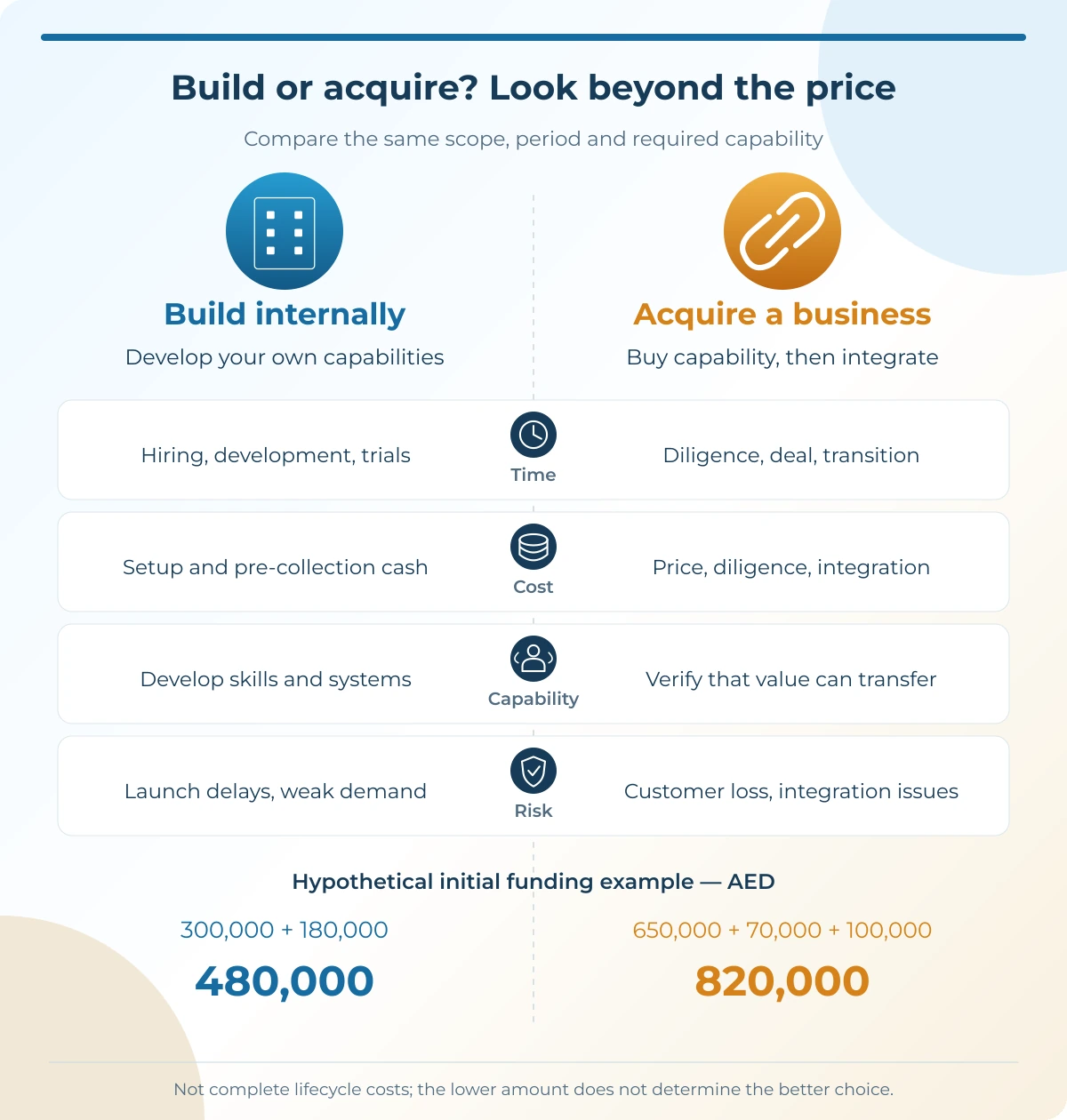
In a simplified hypothetical example, building requires AED 300,000 for setup and AED 180,000 for the launch cash requirement: AED 480,000 in total. Buying requires AED 650,000, plus AED 70,000 for investigation and transition and AED 100,000 for integration: AED 820,000. These are initial funding amounts, not all the costs incurred throughout the business’s operating life. The lower figure alone cannot justify building because the options may deliver different capabilities, revenues and timing.
Test what you are actually buying
Due diligence tests assumptions and risks before a final commitment. BDC’s guidance highlights commercial, financial and legal examination [2]. Request documents supporting material claims instead of relying solely on the seller’s presentation. Examples include contract terms, revenue sources, how regularly they recur and whether they can be collected, obligations and ownership of the assets essential to service delivery.
Ask where the value resides. Is it supported by continuing contracts or by the owner’s personal relationships? What happens if a key employee leaves? Can the technology or content still be used after the transaction? Review these questions with relevant specialists for the country and deal structure. In the UAE and wider Gulf, do not assume a licence, contract or approval automatically transfers simply because ownership changes.
Make integration part of the decision
Integration establishes how the businesses will operate after acquisition. It does not mean changing everything immediately. Decide what requires alignment, such as financial reporting and authority, and what should remain temporarily to protect customers. BDC’s structured acquisition approach includes integration planning, systems and retention of employees and customers [3].
Assign a clear owner, set transition priorities and monitor service, cash and critical skills. Differences in working habits and management practices between the companies appear in everyday decisions: who approves a discount, how problems are escalated and how much independence teams retain. If management is already struggling with existing operations, an acquisition may add more responsibility than it can handle, even when the target business appears attractive.
Choose the option you can execute
Use a comparison table covering the objective, timing, funding, risks and required capabilities. Each criterion can be given a relative importance in the final score according to the company’s priorities, but a score cannot replace missing evidence. Establish non-negotiable conditions, such as clear ownership, affordable funding and regulatory feasibility. Strong scores on other criteria should not automatically make an option acceptable if it fails a fundamental condition.
The answer may be internal development, a suitable acquisition or a staged combination. Postponement may be preferable when information or management capacity is inadequate. A strong decision explains why the route serves the objective, which assumptions support it and what would trigger reconsideration. Buying does not guarantee success, and building does not remove risk.
To connect this decision with your company’s direction, read Business Growth Strategy.