



A company can move orders from the telephone to a website while retaining the same revenue model: one product for one payment. Digital tools can also support an ongoing service, usage-based pricing or a combination of an initial sale and recurring support. The difference lies in customer value, what customers pay for and the company’s ability to keep delivering it.
Distinguish the sales channel from the revenue model
A revenue model explains where revenue comes from and how charges are calculated: per item, by subscription, by usage or another basis. A channel explains how the offer reaches the customer. An online store can change the channel without changing the model. Conversely, an ongoing service contract can change the model even if a sales team still handles purchasing.
The UAE Digital Economy Strategy provides a broader context for developing digital activities [1]. It does not prove that subscriptions suit every company. Begin with customer needs. Does the buyer want ownership, reliable availability or access to expertise when needed? Answers differ by activity and segment and should be tested before building a platform or changing contracts.
Compare subscription, usage and hybrid pricing
Compare charging methods for the same hypothetical service, rather than comparing unrelated businesses. Suppose one unit means a support request with a defined scope, and its variable delivery cost is AED 30. Consider a monthly subscription of AED 300 including up to 8 units, pay-per-use at AED 100 per unit, or a hybrid combining a fixed fee and a usage charge: AED 150 monthly plus AED 50 per unit. All calculations below assume payment is collected and service quality is comparable.
| Monthly use | Subscription contribution (AED) | Pay-per-use contribution (AED) | Hybrid contribution (AED) |
|---|---|---|---|
| 1 unit | 270 | 70 | 170 |
| 3 units | 210 | 210 | 210 |
| 8 units | 60 | 560 | 310 |
Each amount is revenue minus variable delivery cost for one customer, before fixed costs, acquisition, development, financing and tax. At 3 units, all three models charge AED 300 and incur AED 90 variable cost. This is the usage assumption behind the subscription example and diagram below. At 8 units, the subscription still charges AED 300, while pay-per-use charges AED 800 and the hybrid AED 550.
The larger contribution is not automatically the better offer: customers may reject an unpredictable bill or a high charge. A subscription gives a predictable bill within its stated allowance, while the supplier incurs additional costs if the customer uses more within the allowance without paying a higher subscription. Usage pricing transfers more volume variation to the bill. The hybrid shares part of that risk. Define what a unit includes, what happens beyond the allowance and how disputed measurements are resolved before choosing technology.
Calculate customer revenue and service costs before building the platform
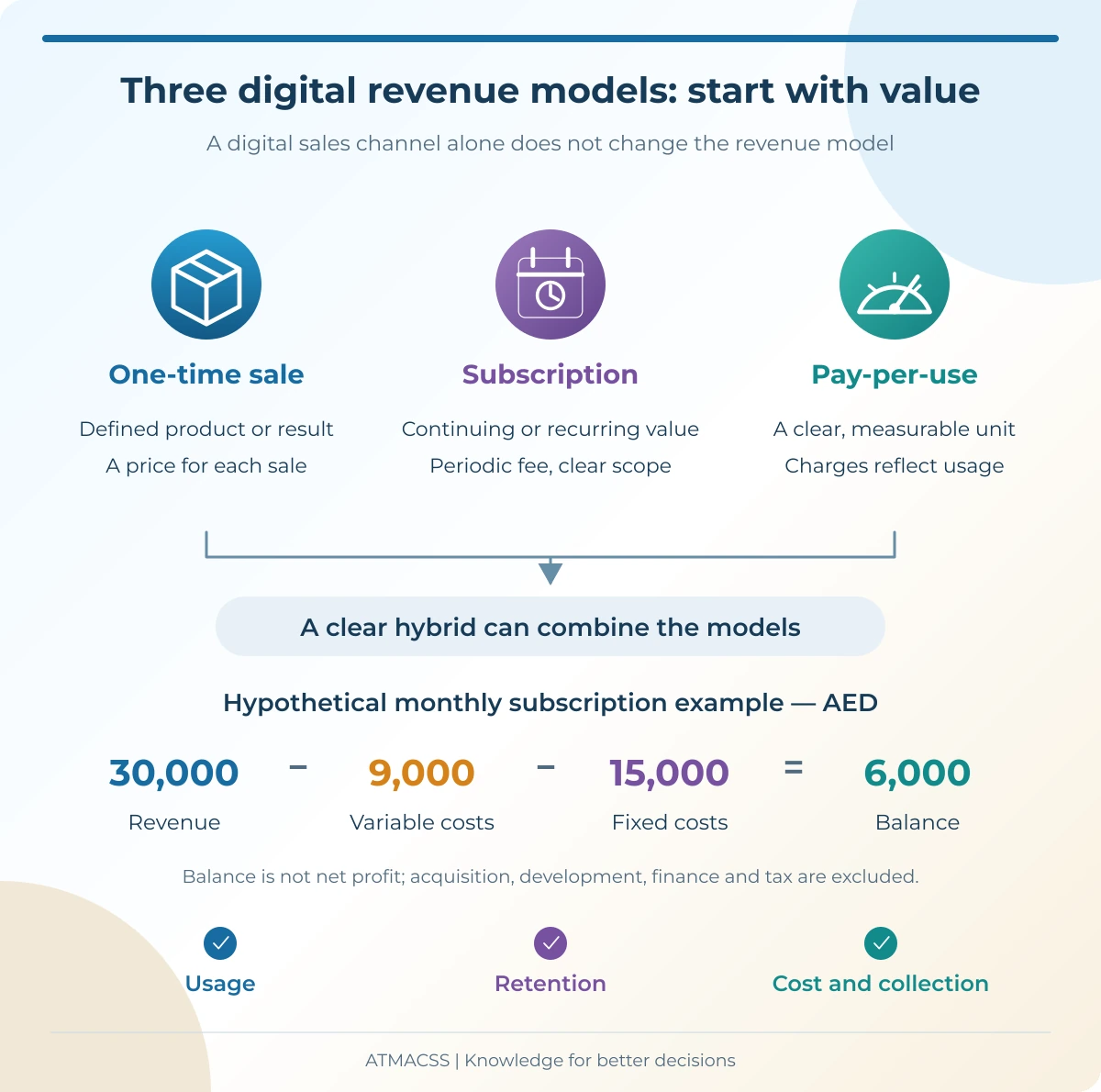
In a hypothetical example, a company sells digital monitoring support for AED 300 per customer per month. With 100 paying customers, monthly revenue is AED 30,000. A variable service cost of AED 90 per customer totals AED 9,000. This leaves a contribution margin of AED 21,000 before fixed costs, acquisition costs and other items.
If monthly fixed operating costs are AED 15,000, the model leaves AED 6,000. This is not net profit: customer acquisition, financing, tax and initial development costs are excluded. The calculation also assumes full collection and unchanged service costs. Support demands may increase with usage or complexity, changing the result.
Suppose acquiring one customer costs AED 630 and their monthly contribution before deducting fixed costs is AED 210. The simplified payback period is 3 months: 630 ÷ 210. It ignores customers cancelling their subscriptions, collection delays and changing costs. If the customer leaves after two months, acquisition spending may not be recovered. Recurring revenue should therefore not be confused with recurring profitability.
Design delivery and commitments alongside pricing
A monthly price creates a repeated delivery commitment. Define what the subscription includes, what attracts an extra charge, response times, usage limits and cancellation arrangements. Avoid “unlimited” promises without understanding heavy usage. Clear terms help customers compare offers and help the service team deliver what was actually sold.
Digital billing needs accurate records, access controls, appropriate data protection and a process for errors and complaints. Check official requirements relevant to the activity and countries served before launch. Do not assume an external payment platform takes over every responsibility. Plan how service will continue if a technology provider fails or a payment method becomes unavailable.
Pilot with a small group and track continued subscriptions
Start with a clear offer and a defined segment without moving every customer at once. Existing tools may be sufficient for a trial if they meet requirements and protect data. The purpose is not to prove that an application can be built. It is to establish that customers use and pay for the service at a sustainable delivery cost.
Track when customers start using the service, how much they use it, subscription renewal, cancellation, support costs and collection. Distinguish customer losses from revenue reduction: accounts may remain while moving to cheaper plans. Compare groups that joined in similar periods, because new subscribers differ from experienced customers. Ask departing customers why they left instead of treating every cancellation as a pricing problem.
Change the model when the benefit is clear
Expand the trial when customers receive recurring value, delivery is stable and financial contribution remains suitable after relevant costs. Retain traditional sales where they better suit another segment. Combining a one-time product purchase with optional ongoing support may be more appropriate than imposing subscriptions on everyone.
Digitalisation creates options but cannot make management’s decision. Begin by asking which value the business can deliver, measure and renew. Pricing, contracts and technology follow. If the answer is unclear, improve the offer before increasing spending. A successful model is demonstrated by customer use, continued subscriptions, and revenue compared with service costs, rather than the number of platform features.
To connect this decision with your company’s direction, read Business Growth Strategy.