



A new-market idea may begin with a customer enquiry or a trade-show meeting. That is worth exploring, but it does not yet justify an office lease and a permanent team. Before committing to Gulf market entry, a company should test demand, pricing and customer access. The purpose is to gather evidence for an appropriate commitment while checking that each activity is permitted.
Define the opportunity precisely
Do not start with “Saudi Arabia is a large market” or “we see an opportunity in Oman.” Identify a specific customer, a defined problem, and a service or product with clear pricing and terms. It could be maintenance for medium-sized facilities in one city, or a service that reduces stock errors for a retail chain. Broad definitions make test results harder to interpret.
Write a testable hypothesis: this customer group has the problem, will pay a particular price and can be reached and served through the chosen method, such as direct sales or a partner. Separate what you know from what you assume. An interested enquiry demonstrates interest, but not an approved budget or purchasing authority. Understand the buying process, timing and alternatives currently used.
Gather customer and market evidence
Begin with short interviews among potential buyers in the same segment. Ask how they handle the problem, what fails and who approves spending. Avoid relying on “Do you like this idea?” People may be polite or describe a preference without intending to buy. A specific quotation request or permitted trial gives stronger evidence, although neither guarantees a sale.
Review competitors, published prices and distribution channels, then identify a customer need that existing options do not meet well and that you could serve. Do not assume there is no competition because no supplier exactly matches your offer. An internal team, a simpler solution or postponing the purchase can also compete. SBA market-research guidance includes demand, pricing and competition among the core questions [1].
Choose a limited, measurable test
A test can start with interviews, a demonstration or attendance at a relevant exhibition. It may progress to a limited paid project if regulatory and contractual requirements allow it. The US International Trade Administration’s UAE entry guidance identifies exhibitions, business relationships and partner due diligence as useful market-entry considerations [2].
Set a duration, budget and scope in advance. In a hypothetical example, a service company tests one offer with one segment for 8 weeks. It records meetings with potential customers who have a relevant need and can participate in the purchasing decision, proposals, paid projects and actual delivery costs. Eight weeks is an illustrative planning choice, not a universal rule. Institutional purchasing may take longer, so adapt the test to the buying cycle.
Set continuation criteria before results arrive. Otherwise, it becomes easy to change the rules to justify expansion. Criteria might include positive contribution after delivery costs, reliable execution and interest from more than one independent customer. Meeting counts alone are insufficient. Record rejection reasons too: they may reveal a pricing, channel or offer problem.
Do not treat the Gulf as one regulatory market
A shared language and some familiar business practices do not make national requirements identical. Depending on the country and activity, check licensing, business presence, invoicing, tax, employment, data and import requirements. This is an initial checklist, not a claim that every item applies to every project. Requirements may also differ by authority, location or service type.
The International Trade Administration publishes separate entry guidance for the UAE and Saudi Arabia [2][3]. Here, those guides inform market-entry considerations, not a UAE company’s legal entitlement to trade. They primarily address US businesses. Confirm permitted activity with the relevant authority in the destination country before conducting a commercial trial. A pilot does not remove legal obligations, and a partner does not automatically resolve them.
Compare Gulf market entry routes
Test the same offer through feasible entry routes. Direct cross-border delivery may avoid a new office but increase travel or remote support needs. A local partner may help reach customers, but its fee may reduce the amount left from each project, and you may have less direct contact with the customer. A branch can provide local capacity, but creates fixed commitments before demand is secure. None of these routes is automatically permitted for every activity.
| Route | Cost to test | Operational evidence |
|---|---|---|
| Direct delivery | Travel, remote support and collection | Can the service meet response commitments? |
| Local partner | Partner fee, oversight and support | Who owns the customer relationship and handles failures? |
| Branch | Local staffing, premises and administration | Is repeat demand sufficient to support fixed commitments? |
For an illustrative monthly comparison only, suppose the selling price is AED 10,000 per project. Direct delivery costs AED 7,000 per project including travel. Partner delivery costs AED 8,000 including the partner fee. A branch costs AED 5,000 per project plus AED 30,000 monthly fixed costs. At 6 projects, the respective balances are AED 18,000, AED 12,000 and zero. The branch equals direct delivery at 15 projects: the AED 2,000 difference in delivery cost per project then covers AED 30,000 of fixed costs.
These are hypothetical contribution comparisons, not Gulf market prices or net profit. They exclude setup, financing, tax and other unmodelled costs, and assume the options deliver the same work at the required quality, can handle the same number of projects, and collect payments on the same terms. Confirm the operational and legal feasibility first. Then test repeat demand and support quality; a calculated threshold does not establish that 15 projects will arrive.
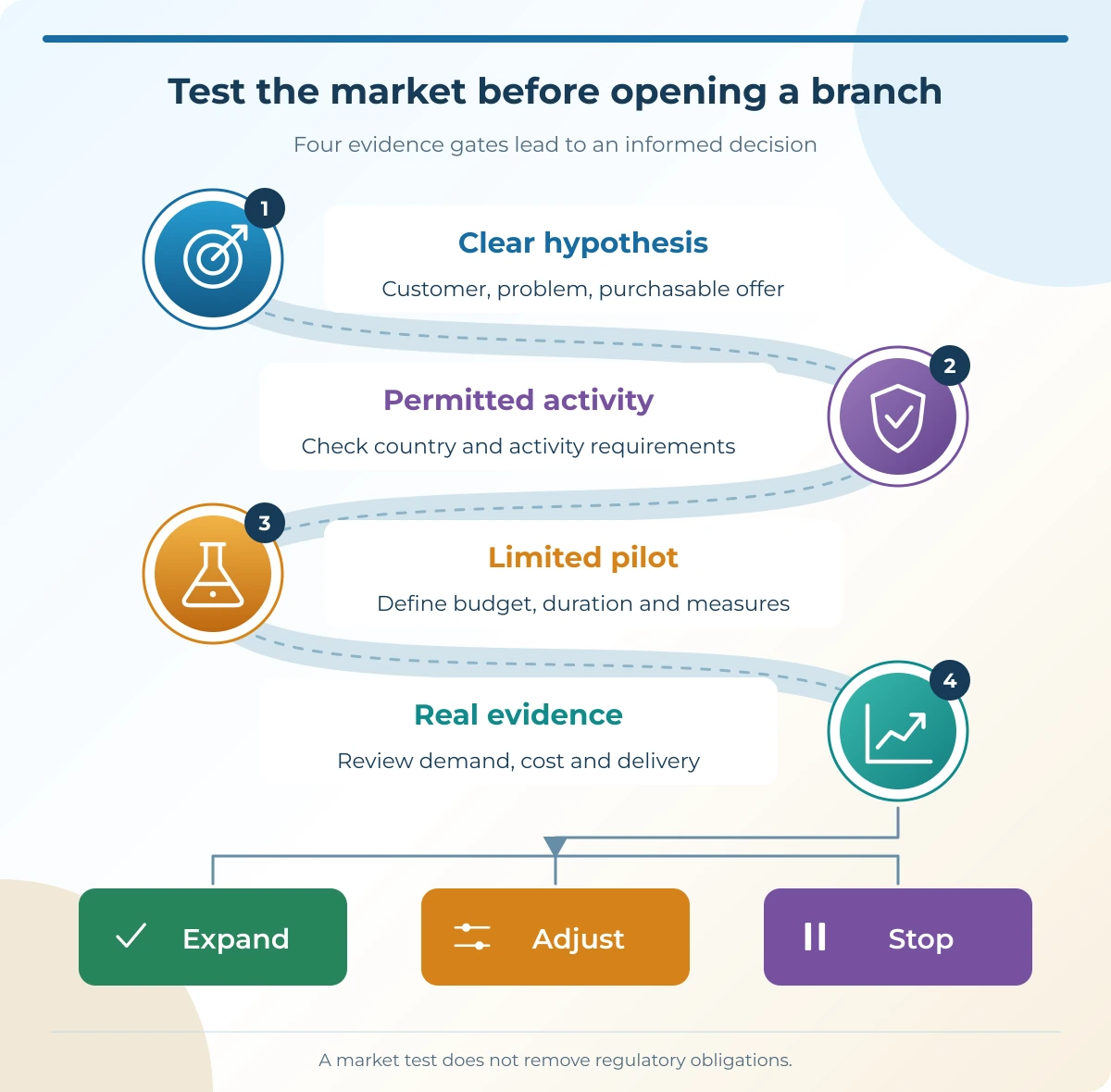
Open a branch when the results justify its cost
After the test, choose whether to expand, adjust the offer or stop. Demand may be real, but best served through a partner for now. Alternatively, service requirements may justify a branch. Compare its additional cost with the expected benefit, and test the effect of slower sales or losing the largest customer.
A useful decision does not require a successful pilot. Discovering that an offer is unsuitable before signing long commitments is valuable too. Keep a record of assumptions, interviews, proposals, costs and verified requirements. Opening a branch then becomes a decision grounded in work the company can deliver, rather than enthusiasm from the first meeting.
To connect this decision with your company’s direction, read Business Growth Strategy.