



Climate change may seem remote from a small service company until supplies are disrupted or a customer requirement changes. A management system asks how the issue could affect its intended results. This article explains how to assess relevance through supply, energy and continuity, then connect the decision with evidence and review without assuming that every company needs identical measures.
Which question needs an answer?
The 2024 ISO and IAF communiqué explains climate considerations added to management systems covered by the amendments. Clause 4.1 concerns determining relevance. A note under 4.2 highlights possible climate-related requirements of interested parties. [1] Check the edition and amendment applicable to your standard before evaluating it.
Relevance means a connection that could affect the system's intended results. That connection may differ between quality, business continuity and safety. A general statement of environmental concern is insufficient. Equally, every environmental impact should not be treated as the same issue.
Start with the result your business needs
The editorial team suggests selecting an important service or product and identifying what delivery depends on. These dependencies might include reliable electricity, cooling, staff access or materials travelling through a particular route. Map these resources and services that delivery depends on before selecting a generic risk list.
In a Gulf context, heat exposure, transport disruption or increased need for cooling may be worth examining according to location and activity. These are assessment topics, not evidence that every facility faces identical risks. Use site information, supplier data and operating records. Do not attribute an individual weather event to climate change without appropriate scientific evidence.
Separate physical effects from changing requirements
A physical effect might alter storage conditions or interrupt a shipment. Another issue could arise through climate-related customer, financing or supply requirements. Identify who requests the condition, its source, scope and timing. Saying that the market favours sustainability is too vague to guide an operational decision.
Every interested party request does not automatically become a company obligation. Examine whether it applies and whether its basis is legal, contractual or voluntary. Decide how the organization will address it. When legal interpretation affects the decision, obtain appropriate specialist advice before converting it into operational instructions.
Hypothetical example: temperature-sensitive material
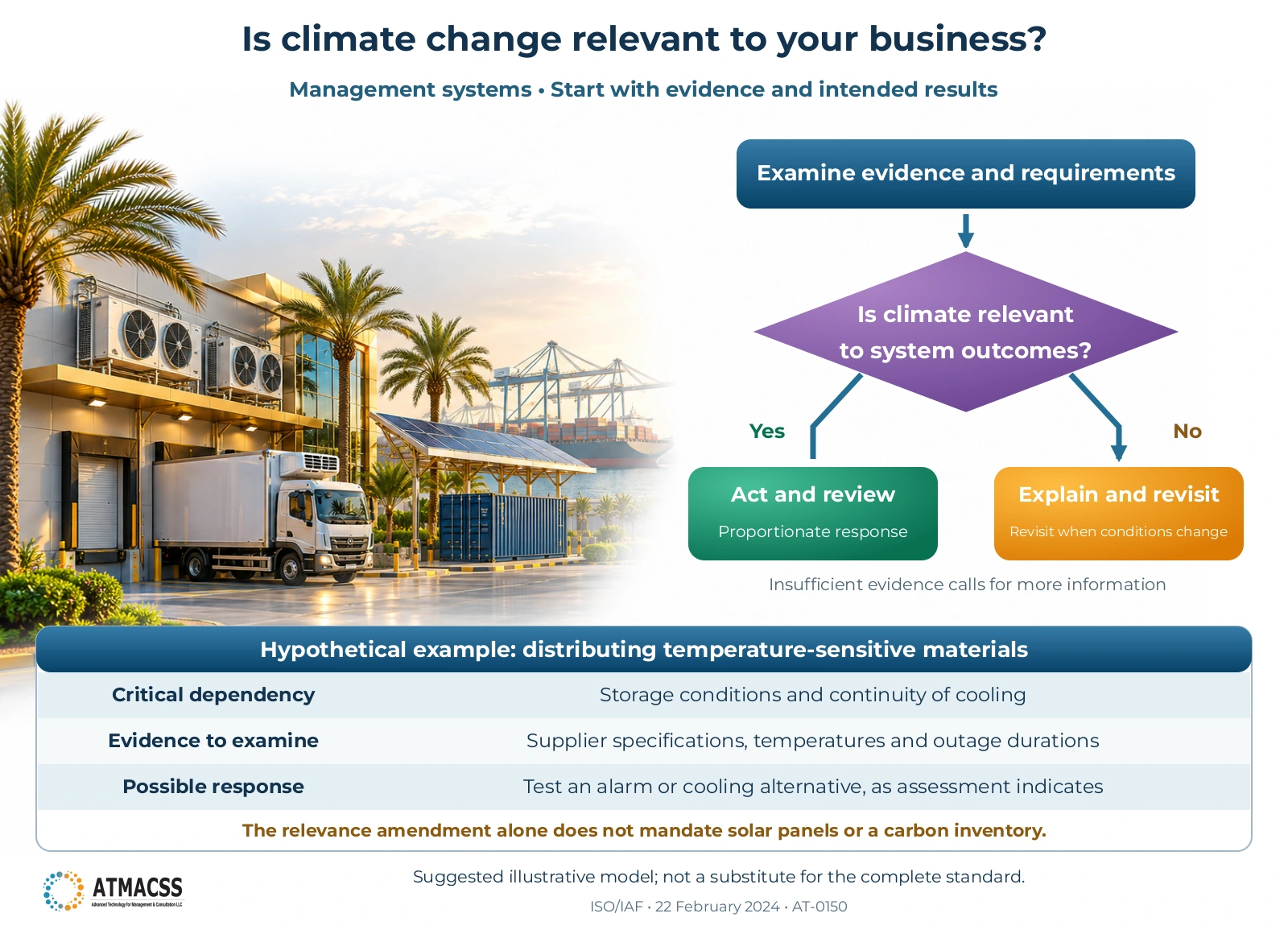
Assume a distributor handles material with temperatures and storage conditions specified by the supplier. It wants to assess whether heat exposure and cooling interruption could cause the material to fall outside supplier specifications or customer requirements. The team gathers storage specifications, temperature records, interruption durations and response arrangements. It then examines whether existing controls are adequate.
If evidence indicates that heat or cooling interruptions could cause the material to fall outside its requirements, possible responses include testing an alarm, backup power or transfer to another facility. These alternatives require technical assessment, cost review and testing. They are not universal mandatory actions. Buying backup equipment alone is insufficient. Check its capacity, start-up time and the people responsible for responding.
Record a decision that can be explained
A short record can connect the intended result, supplier or service essential to achieving it, evidence, decision on whether climate change is relevant, action, owner and review date. This is a suggested organizing method, not a prescribed template. Where evidence is insufficient, record the information needed rather than forcing a definitive conclusion.
An issue may be assessed as not materially relevant within a particular scope at the time of review. That conclusion needs an explainable assessment. Being small or having no factory is not enough. The conclusion may change when the location, service or a major customer's requirements change.
Connect the assessment with existing management
Where relevance is established, decide how the finding affects applicable processes, risks, resources and monitoring. The company may need to change purchasing conditions, test how service would continue after a supplier or power failure, or train staff in a specific procedure. Avoid a separate climate register that process owners never read and that changes no decisions.
Possible measures include how often temperature exceeds permitted storage limits, the time needed to restore a service after interruption, or the result of testing an alternative supplier or supply route. Choose measures that fit the case rather than those easiest to collect. The number of climate meetings does not demonstrate that materials remained within specification or that a service recovered.
What does the amendment not establish?
The relevance addition alone does not justify concluding that every company must install solar panels or prepare a carbon inventory. Other requirements may arise from a specific standard, law or contract and need separate assessment. Managing emissions and managing climate effects on operations are related but different subjects.
Start with one important result and trace its resource and stakeholder dependencies. Assess relevance using evidence, revisit the decision when conditions change and test the chosen response. This makes the assessment part of everyday management rather than a general statement added before an auditor's visit.
To connect these steps to a system that fits your operations, our ISO implementation and certification-readiness service explains the support available, from gap assessment to readiness review.