



Orders are delayed, so the team proposes a new system. Yet the delay may arise from missing information, unclear ownership or unresolved approvals. A transformation readiness assessment examines those causes before approving a solution and spending money on it. This article explains how to gather evidence about processes, data, capabilities and governance, then decide whether to repair the workflow, run a trial or invest in technology.
Define the problem to be changed
Transformation readiness means having the conditions needed to implement, operate and sustain a defined change. It does not mean owning the latest software. A company may be ready for a small trial but not a rollout across every branch.
Describe the problem without naming a product: “Orders are repeatedly returned because customer information differs”, rather than “We need a customer relationship management (CRM) system”. Identify who is affected, when it happens and the required outcome. GOV.UK discovery guidance emphasises understanding users, problems and constraints before committing to build.[1]
Treat the team’s explanation as a hypothesis. “The system is slow” might describe an unresponsive screen or waiting for a decision. These require different interventions. Separate them before paying to improve the wrong thing.
Examine the process and its data
Follow one transaction end to end. Record movement between people and systems, repeated data entry, waiting time and unusual cases. Identify the decision-maker when information is missing or requests conflict. Compare written procedures with actual behaviour under workload pressure.
Inspect the accompanying data. Do terms have shared definitions? Are customers and products identified consistently? Can staff locate the authoritative record? Moving conflicting data into a new system may simply move the problem faster.
Hypothetical example: a distributor wants faster order confirmation. Two teams interpret “approved customer” differently. Before designing connections and data exchange between systems, they must define the status, its owner and change conditions. This is a business and data question before it becomes a technical configuration.
Test technical limits
Where evidence suggests a technical constraint, reproduce it under representative conditions. Measure response time for the affected operation and examine errors, data exchange between systems, access permissions and whether the system continues working without failures. The cause may be configuration, connectivity, licensing or a capability the product does not provide.
Ask the provider what the product supports now, what needs development and what it cannot do. Use the company’s scenario with suitable fictional data during demonstrations. Attractive screens do not establish successful handoffs or exception handling.
Consider how data will move from the old system to the new one and how work will continue after launch. Who cleans the data? How will balances and records be reconciled? How will the company return to the previous system if the move fails, and who provides support? A successful demonstration does not answer those questions automatically.
Check people and decision ownership
Capability includes business knowledge, available time, training and support, not just screen familiarity. Identify who will test the change and how their regular workload will be covered. A plan cannot assume unlimited participation from a fully occupied team.
Governance defines who decides, approves and reviews outcomes. Name the people responsible for the way work is done and for data accuracy, the person authorised to approve the budget, and the person who checks and accepts the results. Establish how disputes and scope changes will be resolved. A project manager cannot substitute for missing business decision-makers.
Identify conditions that prevent a safe start, such as missing data usage rights or no operating owner. Good scores elsewhere cannot compensate for them. An average readiness score can hide a single reason to postpone expansion.
Connect causes with actions
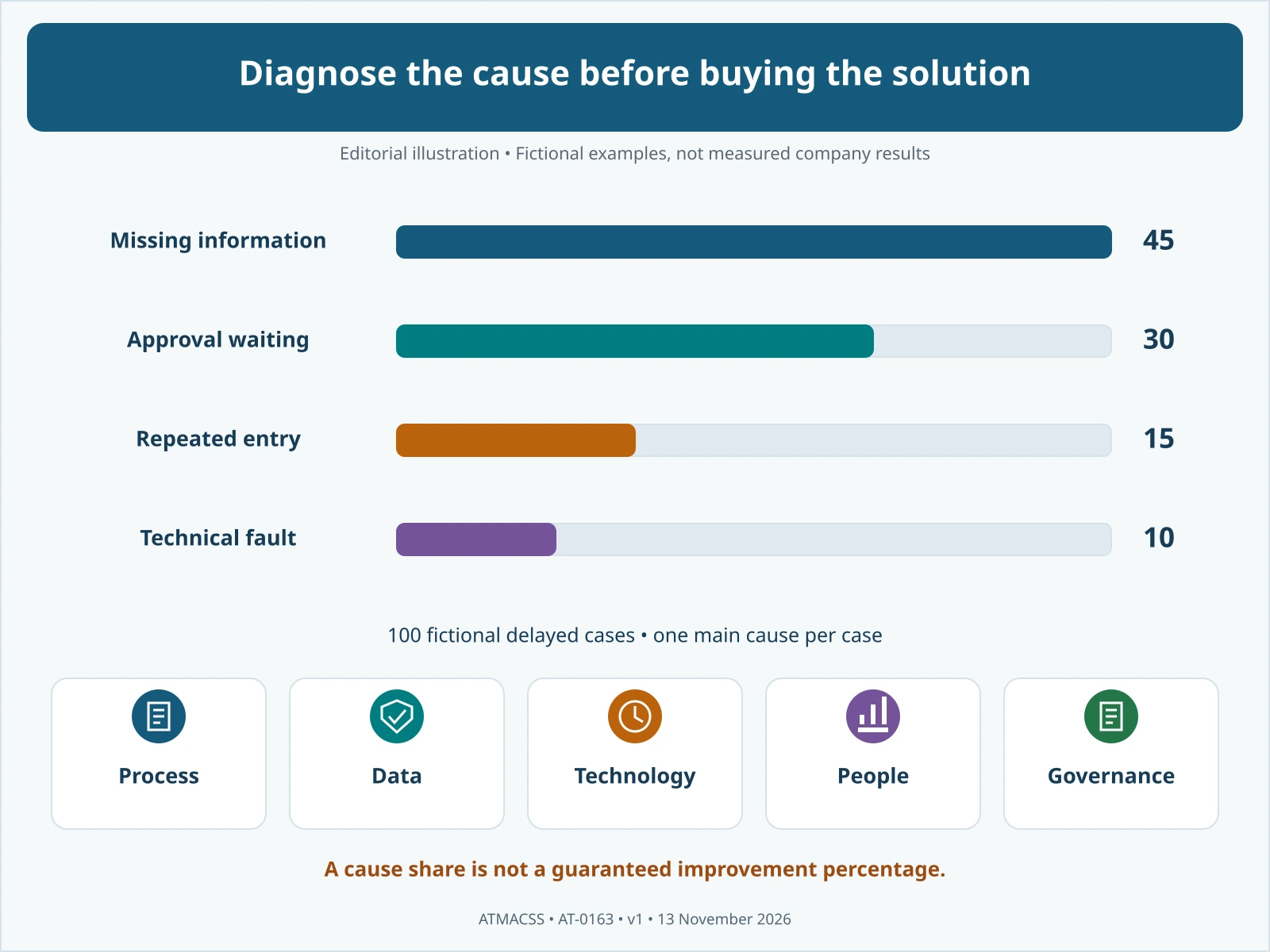
Hypothetical example: 100 delayed cases are classified once by their main cause. Missing information accounts for 45, waiting for approval 30, repeated entry 15 and technical faults 10. These are not market statistics and do not establish that real cases have only one cause.
The team proposes a completeness check at intake, clearer approval authority and then a trial of data transfer. Technical faults receive separate investigation. The figures do not prove that fixing data will remove 45% of delay. Causes may interact, or another queue may emerge.
After each trial, compare similar cases and record sample size, period and operating changes. Examine quality and rework too. A better average is insufficient if errors increase or difficult cases deteriorate.
End with an executable decision
The assessment should produce evidenced gaps, accountable owners and dependencies between actions. The decision may be process repair, a bounded pilot, procurement requirements or postponement. State the conditions for moving forward and how completion will be demonstrated.
Begin with one important transaction and investigate it before selecting a solution. A clear cause, defined changes, named responsible people and stated conditions for accepting results make a technology investment assessable. Buying a system does not automatically resolve unclear work.
This diagnosis can inform business and operation modelling, linking the desired outcome with capabilities, responsibilities and supporting technology.