



A small company may need regular financial leadership without requiring a full-time finance director throughout the week. A fractional executive is one arrangement worth considering. This article compares it with consulting and interim management, and explains how to assess scope, authority, availability, and cost. A lower headline fee is not enough to establish that the arrangement fits the work.
What does fractional executive mean?
A fractional executive provides leadership and execution expertise for an agreed portion of time. The person may work with several organisations. ICAEW describes finance professionals operating this way for several clients, allocating part of their time to each.[1] The label does not guarantee suitable experience or establish a single legal form of engagement.
Examples include a fractional finance director or operations leader. What matters is the actual work, reporting relationship, and delegated authority. In the UAE, determine the applicable contractual arrangement and licensing or permit requirements for the circumstances. An English job title does not automatically confer permission to work or sign for a company.
Compare three different needs
A consultant helps diagnose a problem or develop a solution within an agreed scope. Consultants may support implementation, but do not automatically hold daily management authority. A fractional executive undertakes recurring leadership responsibilities to the extent delegated, such as leading financial reviews and following through on decisions.
A full-time manager ordinarily provides broader day-to-day availability, depending on the actual role. An interim manager fills a role for a defined transition period and may work full-time or part-time. Interim describes the engagement’s duration; fractional describes the allocation of time. Both descriptions can apply together.
These are practical distinctions, not rigid rules for every contract. Compare written responsibilities rather than assuming a universal meaning for the title. A one-off diagnostic report may need a consulting engagement. Frequent urgent decisions may require more availability than a limited fractional arrangement can provide.
Check that working time matches when decisions are needed
Examine the decisions arising across a week, not just the number of meetings. Can they be handled on agreed days? Who addresses urgent matters between those days? Is there a team able to implement the agreed actions? Leadership expertise cannot replace missing staff or essential information.
The arrangement may suit an established operating team needing regular specialist leadership within a clear scope. It is weaker where the role requires continuous daily attention that the contract cannot supply. If incomplete records or an unstable process are the main problem, repair those foundations before assuming that another senior title will solve them.
Ask the candidate to explain how competing commitments are handled. Working days, hours, and contact outside those hours should be agreed, not an assumption based on willingness during the sales conversation. Clarify contact routes, expected response, and situations requiring an alternative decision-maker.
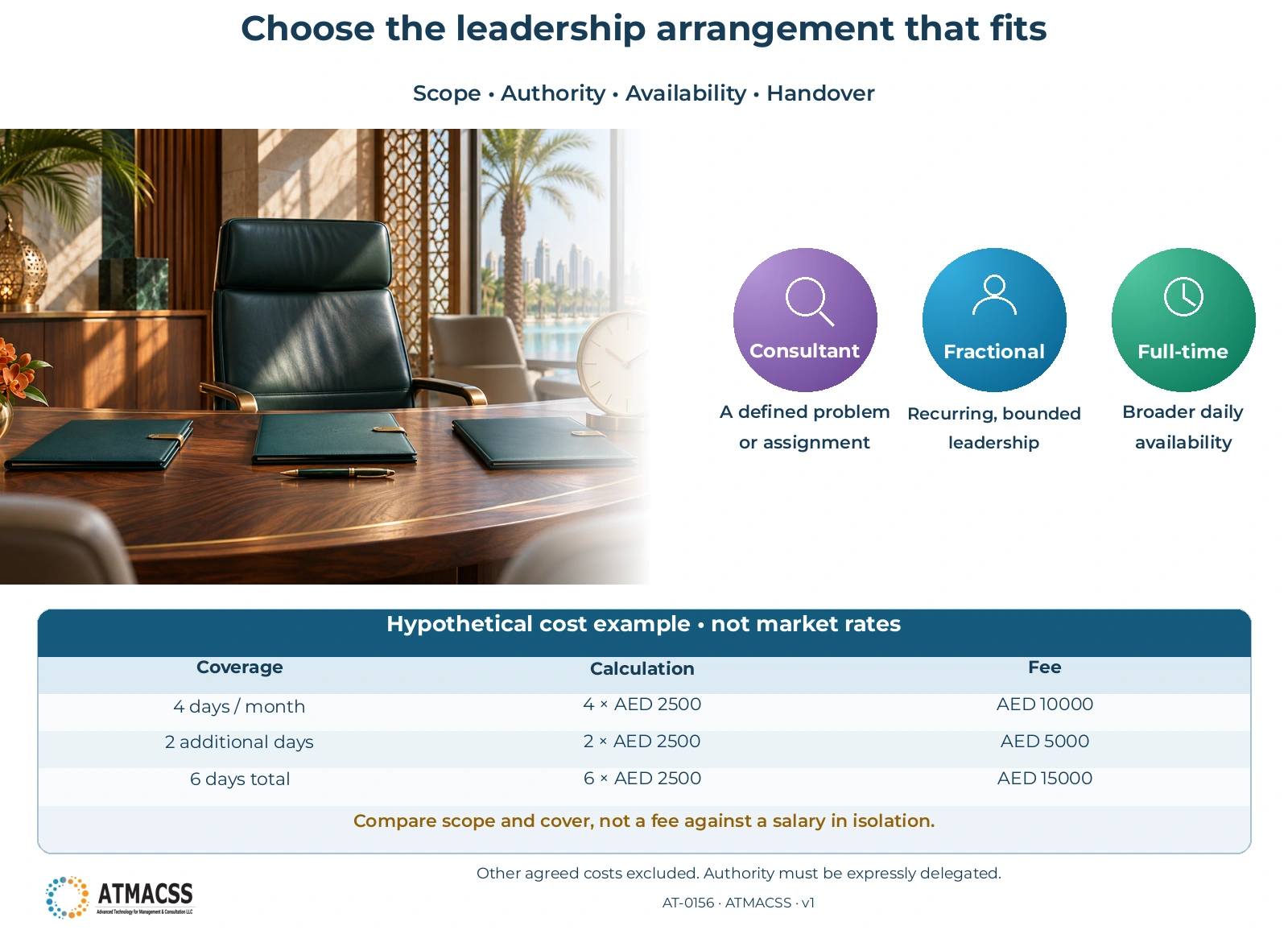
Hypothetical example for illustration: weekly financial leadership
Assume an executive works 4 days a month at a hypothetical AED 2500 per day. The basic monthly fee is AED 10000. If the company needs 2 additional days on the same terms, that becomes AED 15000 before other agreed costs.
These are not market rates or an ATMACSS offer. The example shows why comparison should go beyond a basic fee versus salary. Compare the executive’s working hours and who covers their absence, responsibilities, additional time, and applicable costs over the same period. Lower cost is not useful if important decisions remain without an available owner.
In this example, the executive leads the preparation of estimates of money expected to enter and leave the company, and reviews actual results against those estimates with the team. Payment approval remains with the designated authorised person. If daily approval is needed, provide suitable cover instead of assuming unlimited availability outside contracted days.
Define authority and accountability
Specify what the executive recommends, what they may decide, and what requires another person’s approval. Grant system access according to the work. Responsibility for improving collections should not become unrestricted authority to alter accounts or transfer funds.
Record what work must be delivered and when, who receives problems beyond the executive’s authority, and who handles the work during an absence. Discuss conflicts of interest when the executive serves other organisations, and define confidentiality boundaries. Do not use a title implying board membership or signing powers that have not been formally established. A business card does not replace delegation.
The company should also identify an internal owner for the relationship. That person resolves scope questions and ensures departments cooperate. Without this support, the executive can spend limited time pursuing information rather than performing the leadership work the company needs.
Evaluate work through evidence
We suggest beginning with a defined scope and agreed review point. Evidence might include an updated cash forecast, recorded decisions, people responsible for carrying out the decisions, and follow-up on why actual results differ from forecasts. These outputs demonstrate activity and decision support. Profit changes may reflect several factors beyond the executive’s control.
Before expanding or ending the engagement, identify who receives the files, who follows up decisions still to be made, and who reviews access permissions to transfer or remove them as needed. Keep knowledge within the company rather than relying on a personal account. If the role grows into a daily need, reassess the arrangement instead of loading full-time expectations onto a limited contract.
Start with the need, not the title
A fractional executive can suit recurring leadership work that fits clear time and authority boundaries. Consulting may suit a defined problem requiring analysis or a solution. Broad daily needs may require greater availability. Describe the work and how its outputs will be accepted, then choose an arrangement capable of delivering it.
For support connecting leadership needs with company growth priorities, see our business development service.