



A candidate can describe experience confidently, but can they perform the required task? Skills-based hiring connects selection with evidence of performance. The company defines the work, chooses a suitable sample and evaluates it against clear criteria. This article explains how to design a practical assessment, interpret its result and recognise its limits. Its focus is assessment design after the role requirements have been established.
Turn a skill label into observable evidence
Skills-based hiring makes job-related capability an important basis for comparison. It does not remove a required qualification or professional licence. It does challenge the assumption that a university name or years of experience proves every relevant capability.
“Good at problem solving” gives assessors little to observe. Replace it with an action: identify a delivery conflict, request missing information and propose an option within the role’s authority. The assessment then relates to actual work, and another person can review the assessor’s reasoning.
Separate capabilities needed on entry from those the company will teach. Testing an unfamiliar internal system may measure prior exposure rather than professional ability. U.S. Office of Personnel Management (OPM) guidance explains that work samples suit competencies expected on entry and require capable assessors.[1]
Build a small but complete work sample
A work sample recreates a defined part of a job. Select work that matters because it recurs or carries an important risk. Prepare fictional inputs, clear instructions and an output that can be inspected. Do not turn the assessment into an unpaid commercial project.
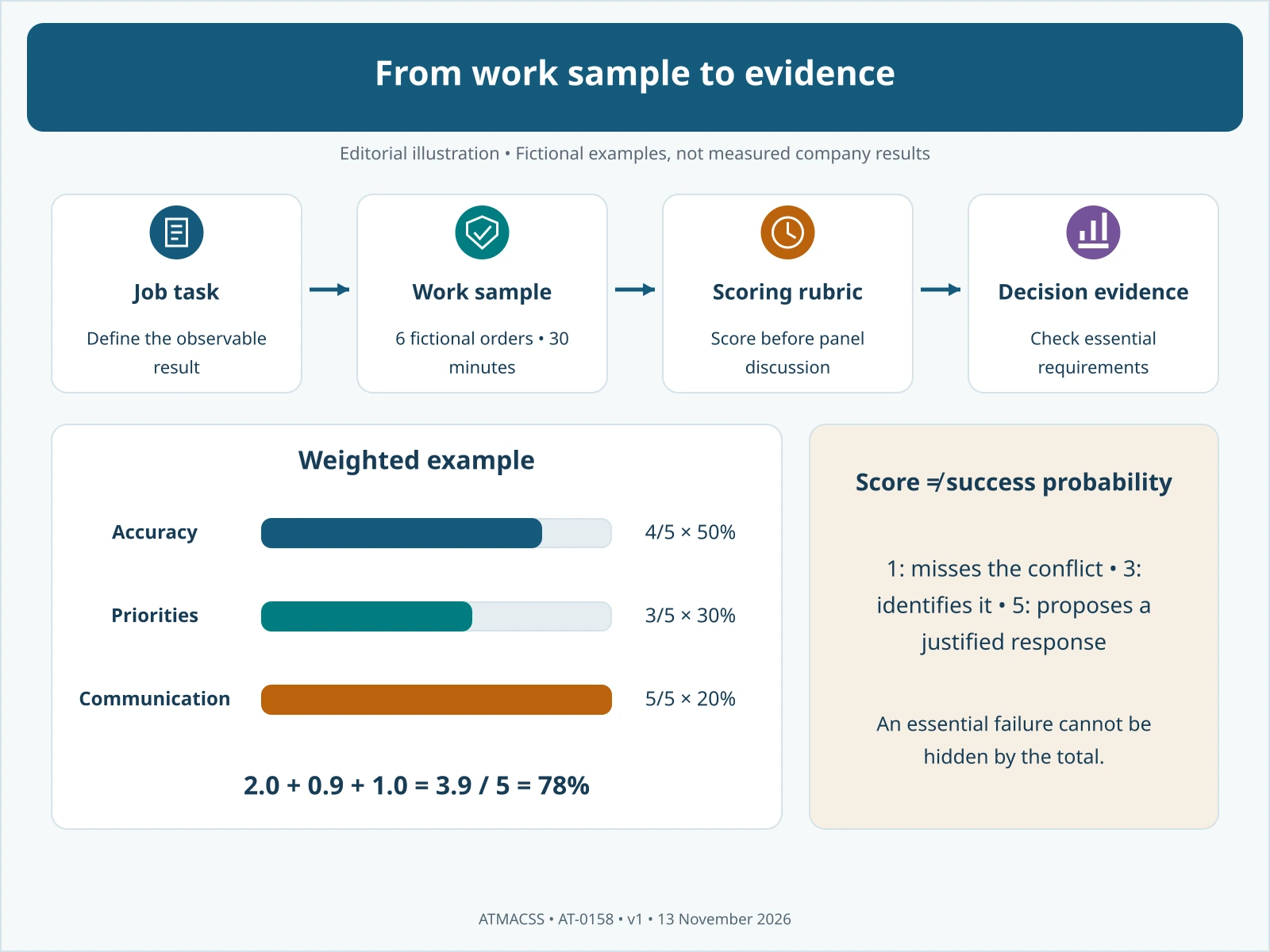
Hypothetical example: a company is recruiting an order coordinator. The candidate receives 6 fictional orders, including an incomplete address and conflicting delivery times. They must prioritise the orders, identify questions and write a short customer response. The proposed allowance is 30 minutes, subject to a pilot confirming that it is realistic.
State which tools candidates may use. If AI assistance is allowed, ask how its output was checked. If performance without AI assistance is being assessed, explain that restriction and apply it consistently. Do not change the rule after seeing candidates’ results.
Define scoring before reviewing responses
Make the exercise executable with these fictional cases. Order A is complete and due today. B lacks a building number. C conflicts with A, with only one vehicle available. D is due tomorrow. E requests an unconfirmed address change. F asks for a delivery promise beyond the authority stated in the instructions.
There is no uniquely correct ordering without further assumptions. Candidates should explain priorities, hold commitments requiring missing information and refer conflicts to the person authorised to decide. Promising a fast solution is not automatically better. Request two outputs: a decision table for all orders and a brief response distinguishing confirmed information from pending follow-up.
The answer key identifies expected evidence: detecting B’s missing information, the A–C conflict and E’s unverified address change. It also checks that F receives no unauthorised promise. Accept alternative solutions that respect the constraints and provide sound reasoning. This tests practical judgement rather than memorising the designer’s preferred sequence.
A scoring rubric describes the performance represented by each score. A scale from 1 to 5 can work if its levels have clear meanings. For conflict detection, 1 might mean missing the conflict, 3 identifying it without a complete response, and 5 proposing a justified resolution. These are examples of what each score means, not a universal hiring standard.
Use separate criteria for accuracy, prioritisation and communication. Avoid scoring the same strength repeatedly under different labels. If a confidentiality breach is a rejection condition, define that essential requirement in advance. A strong overall score must not conceal failure against it.
In a hypothetical example, accuracy contributes 50% of the final score, prioritisation 30% and communication 20%. A candidate scores 4, 3 and 5 out of 5. The weighted result is 4 × 0.50 + 3 × 0.30 + 5 × 0.20 = 3.9 out of 5, or 78%. This is not a 78% probability of success, and it is insufficient as a decision by itself.
Make comparisons fair and explainable
Provide the same core instructions and equivalent time and tools. Arrange necessary accommodations without changing the essential capability being measured. Avoid testing typing speed when the job primarily needs analytical accuracy. Do not introduce an unnecessary language requirement indirectly through the task.
Ask someone who understands the work to try the exercise before giving it to candidates. Have assessors score a trial response independently, then discuss differences. Clarify ambiguous descriptions of score levels rather than adjusting an inconvenient result. During real assessment, each assessor should record evidence before the group discussion.
A structured interview can explore evidence the sample does not reveal. It asks about relevant past behaviour or a defined hypothetical situation. OPM guidance supports consistent questions and scoring standards.[2] Use the interview to understand reasoning or reactions to missing information, rather than repeating the work sample without purpose.
Use the result, then review the assessment
Combine evidence against each essential requirement. Distinguish demonstrated ability from an unresolved question. A focused clarification may be more useful than restarting the entire process. Explain how candidate information will be handled, restrict access and set retention arrangements against applicable obligations. Keep real customer names and files out of the exercise.
After hiring, compare the assessment with the work actually required. If an employee passed the test but struggles at work, inspect training, supervision and operating conditions too. Do not automatically attribute the difference to the person or the test. Review the exercise when the role changes and retain its version history.
Begin with one task, its expected output and a scoring rubric. Pilot it before using it with candidates. A useful assessment produces evidence that can be explained. Its fairness depends on design and delivery, not the label “skills-based”.
The same evidence of capability can inform development after recruitment. Our corporate training and coaching service connects learning needs with job-related practice and evaluation.