



An AI tool may shorten drafting time while increasing the effort needed to check the result. Job redesign therefore starts with the whole task, including decisions and follow-up. This article explains how to separate assistance from automation, allocate responsibility, and create a workable role. Time saved on one activity does not automatically mean that a position is no longer needed.
A job connects responsibilities
Job design establishes a role’s responsibilities and working relationships. CIPD connects it with both effective work and job quality.[1] Redesigning work around AI means reconsidering that arrangement when some tasks change. Adding a software subscription to an existing role does not, by itself, achieve this.
Consider a customer-service employee who reads a request, understands the circumstances, finds an answer, replies, and follows up. These are several connected tasks. AI may help with searching and drafting. A case that does not fit the usual steps may still need someone who understands what the company promised the customer. Examine each task and its required result, then combine the tasks into a job with clear, connected responsibilities.
Separate assistance from automation
AI augmentation means supporting a person’s work. A tool might suggest a reply that the employee checks and decides whether to use. Automation executes a step under a defined arrangement without human involvement on every occasion. Not all automation uses AI.
For planning purposes, we suggest 3 arrangements: human execution, AI assistance with review, and automated execution within controlled limits. This is an editorial planning method, not a legal classification. Repetition alone should not determine the choice. Consider the consequences of error, data sensitivity, and whether mistakes can be detected and corrected before affecting others.
In the service example, a team could test drafting replies about opening hours using approved information. Deciding a disputed compensation request requires appropriate authority and review. A system’s technical ability to issue a decision does not grant it organisational authority to make that decision.
Design the work after drafting
Faster drafting can shift the bottleneck to review. Specify what the employee checks: factual accuracy, suitability for the case, and commitments made to the customer. Provide the time and information needed. Stating that a human will review dozens of outputs is insufficient if that person cannot inspect them properly.
Define when the usual steps must stop so someone can request a decision or help. Missing policy, conflicting sources, or a request beyond the employee’s authority should lead to the appropriate decision-maker. Employees need a way to reject the tool’s suggestion and complete the work through an alternative route. Review becomes ceremonial if rejection is impossible.
The manager should also decide who handles work while the reason for rejecting the tool’s result is being examined. Otherwise, the customer may receive no answer while different teams assume someone else owns the case. These handovers belong in the working procedure, with the role description recording the main responsibility.
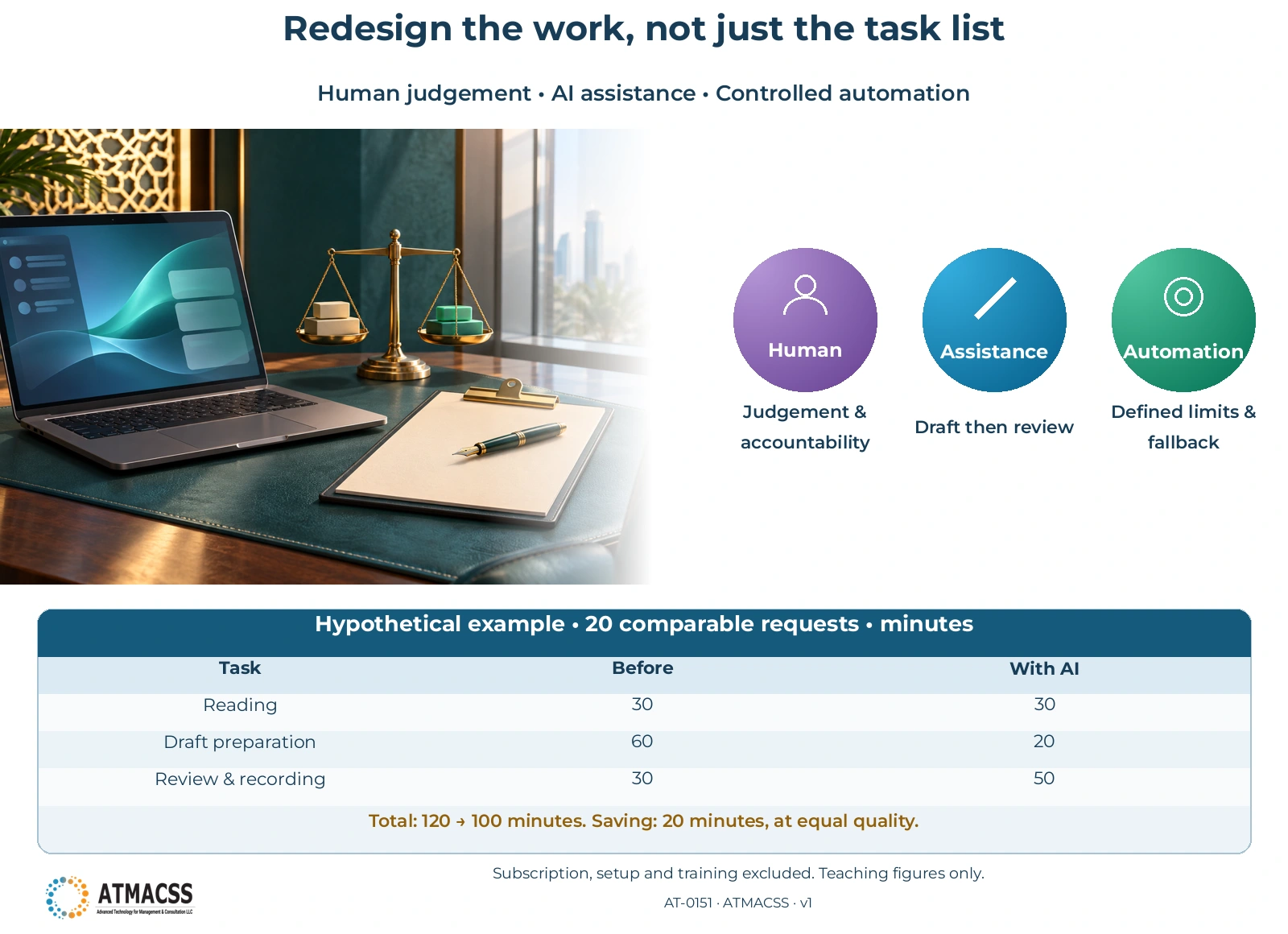
Hypothetical example for illustration: where did the time go?
Assume that processing 20 comparable requests takes 120 minutes: 30 for reading, 60 for drafting, and 30 for review and recording. During an AI trial, reading still takes 30 minutes. Preparing drafts takes 20, while review and recording take 50. The new total is 100 minutes, saving 20 minutes, provided the same acceptable quality is achieved.
These are teaching figures, not measured company results or a productivity promise. Subscription, training, and setup costs are excluded. A reduction in drafting time does not establish a reduction in employment cost. Available time might support complex cases or colleague training, if the benefit persists under comparable conditions.
Compare reply quality, rework, and complaints as well. Testing the tool only on straightforward requests may hide difficulties with unusual cases. Test the arrangement across different work periods, and record why results were accepted or changed. Avoid treating one successful demonstration as evidence for the entire role.
Preserve a meaningful human role
CIPD highlights employee involvement, deliberately using available time for other useful work, and protection of learning opportunities when redesigning work.[2] In practice, ask employees what they need to understand outputs and identify errors. Product knowledge and case analysis may matter more than writing elaborate instructions for the tool.
Keep opportunities to practise the underlying skill. Someone who cannot perform a task may struggle to judge an automated result. Training cases and joint review with an experienced colleague can help. Do not convert expected speed improvements into higher volume targets before examining review demands and service quality.
The remaining tasks should form a job the employee can perform within their available time and authority, with the necessary support. If every simple case is automated, the employee may face a continuous stream of difficult exceptions. Plan workload, support, and recovery time accordingly. Discuss these demands with the employee rather than assuming that fewer routine tasks always make the job easier.
Update the role after testing the arrangement
Record responsibility for execution, review, approval, and exceptions. Update training, permissions, and handovers before revising the job description to reflect the accepted arrangement. Where changes affect employment terms, follow the applicable HR and approval processes. They are not merely wording changes.
Start with one role and clearly bounded tasks. Measure complete processing time, quality, and the employee’s ability to intervene. Useful redesign makes responsibility understandable and gives people work they can perform and check. The number of drafts generated cannot establish that the change succeeded.
For support with responsibilities and workflow design, see our business and operation modelling service.