



Buying corporate training starts with a workplace need, not a catalogue title or a promised number of training hours. A training brief records the need, deliverables and constraints. It lets providers propose relevant learning and lets the buyer compare it fairly. This article explains what to specify, what evidence to request and how to judge delivery without confusing attendance with demonstrated capability.
Confirm that training addresses the problem
Describe the task people struggle to perform and the evidence of the gap. Ask whether the cause is missing skill or knowledge, unclear instructions, unsuitable tools, workload or a decision outside the employee’s authority. Training cannot repair every process or resource problem.
The US Centers for Disease Control and Prevention (CDC) starts its quality training guidance with a needs assessment. This examines the gap and its causes to establish whether training is appropriate. Its public-health context does not make it a UAE training regulation; the principles are used here as a reference for learning design. The procurement workflow below is the editorial team’s practical application to workplace training.
Write the brief around work
Specify the expected participant numbers, learner roles, prior experience, language needs, relevant tasks and the conditions in which learning must be used. Explain whether the programme concerns a new task or improvement in an existing one. Give providers enough context without sharing confidential employee or customer information unnecessarily. State the delivery method, available dates and budget or budget limits where procurement policy permits.
| Brief item | What the provider should address |
|---|---|
| Workplace task | The behaviour learners must demonstrate |
| Starting point | Prior knowledge and known gaps |
| Practice | A relevant exercise with feedback |
| Assessment | Evidence aligned with the learning objective |
| Transfer | Support for applying the learning at work |
A broad objective such as “improve leadership” is hard to evaluate. A more useful objective describes a task, such as conducting a structured feedback conversation using an agreed workplace scenario and criteria.
Compare the substance of proposals
Ask for the session outline, exercise examples, trainer experience relevant to the task, assessment approach and adaptation process. A list of famous clients is not a substitute for evidence of suitability. Verify any claimed qualification or accreditation with the relevant source and check what it actually covers.
Compare scope on the same basis. Include preparation, materials, delivery, assessment, follow-up, travel where relevant and permitted use of materials. A lower day rate can become more expensive if essential preparation or assessment is excluded. Request a breakdown of included and excluded charges, then compare the full cost of the same scope. Clarify different assumptions about participant numbers or practice time before judging price.
Check cancellation arrangements, substitution of trainers, accessibility, venue or platform requirements and the handling of participant information. Record which aspects are mandatory for your organisation and which are preferences, so the selection does not change informally after proposals arrive.
Worked example: handling an incomplete request
A fictional service team needs to handle customer requests missing essential information. Its brief asks learners to identify the gap, ask a clear question and record the next step without making an unsupported promise. The scenario uses fictional customer data.
Provider A offers a presentation about communication. Provider B proposes short instruction, individual practice, observed role-play and feedback against the task criteria. The buyer should examine whether the second design is feasible and well delivered, rather than assuming that a longer slide deck offers more value.
In this example, the brief specifies 3 observable behaviours: identify missing information, request it clearly and record the next step within authority. For each behaviour, the trainer records whether it was completed independently, with help or not completed. Where help is needed, the parties agree additional practice and reassessment. Attendance must not become a substitute for competence evidence.
The acceptance criteria concern the agreed delivery and assessment evidence. After training, the line manager reviews a suitable sample of actual work to see whether the behaviour transfers. Attendance proves participation; it does not establish that every learner can perform the task independently. This educational example does not compare real providers.
Use a sample or pilot to assess suitability
Where the purchase is material or the subject highly specific, request a relevant demonstration or a bounded pilot under agreed commercial terms. Observe whether the trainer explains clearly, handles questions and gives useful feedback. Check the suitability of the language and examples for the learners.
A pilot should answer a defined question about the proposed programme. It should not become an unpaid full assignment or a different course whose success is assumed to transfer. Record what will be adjusted before wider delivery, who approves the change and whether it affects cost or scope.
Agree acceptance and workplace follow-through
Learner assessment examines what a person can do against the learning objective. Acceptance checks whether the provider met the agreed scope and quality criteria. The agreement should also address deficient delivery or inadequate evidence, including who reviews corrections and when.
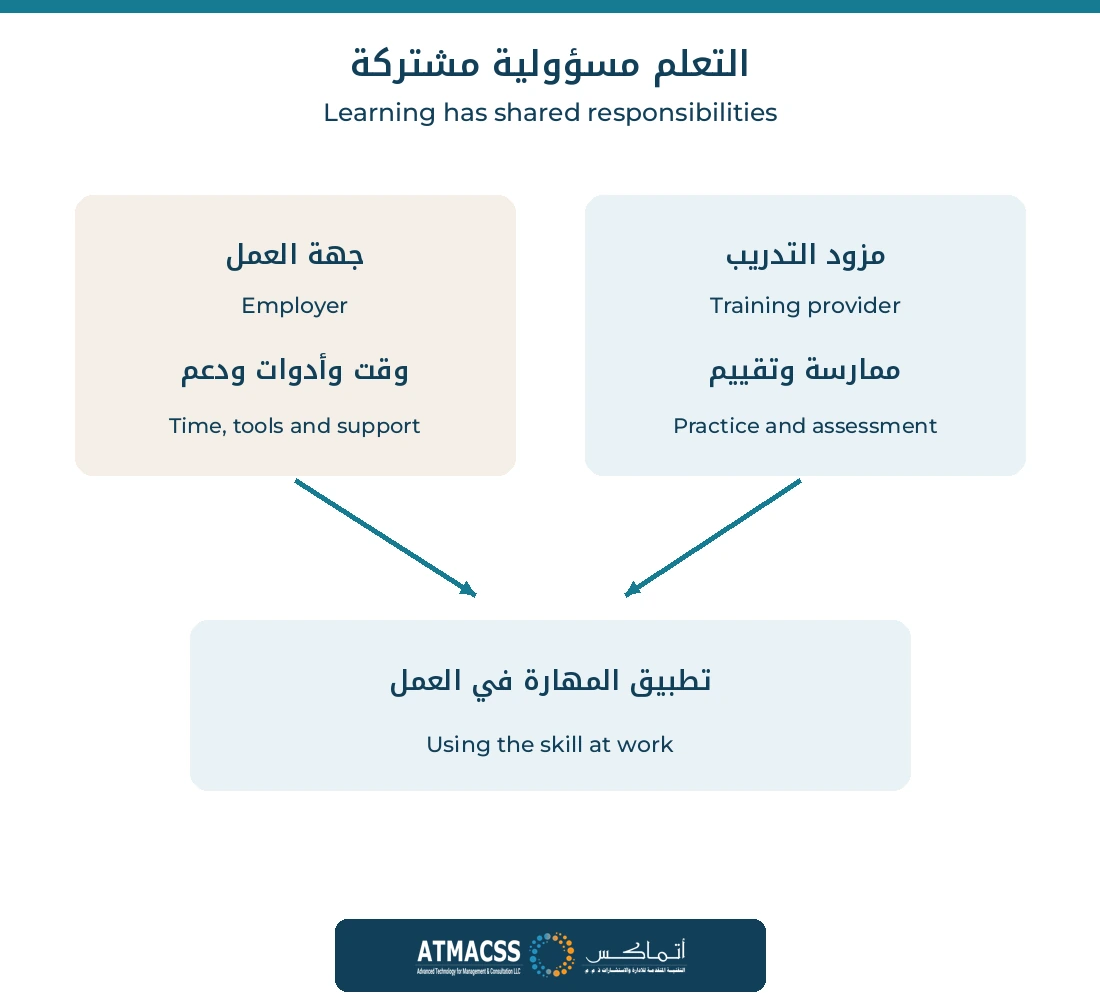
Separate provider deliverables from outcomes influenced by the employer. The provider can deliver the agreed exercises and assessment. The employer must provide time, tools, manager support and opportunities to use the skill. A promise of guaranteed organisational performance from one course overlooks these dependencies.
Agree the evidence to be handed over, such as materials, attendance, assessment summaries and improvement recommendations, while protecting individual information appropriately. Decide who will review the workplace application and when, using a period that fits the task cycle. Do not choose the follow-up date simply because it is convenient.
In the requests example, the manager reviews work after learners have had a real opportunity to apply the skill. They compare it with the starting point using the same criteria, recording request type, working conditions and assistance. If handling has not improved, examine training, instructions, tools and workload before attributing the result to one cause. Better simulation performance alone does not establish better workplace service.
Select using evidence, not presentation polish
Use a documented comparison covering relevance, trainer capability, practice quality, assessment, practical arrangements and total cost. Explain the reason for the selected proposal and any unresolved conditions. If none addresses the need, revise the brief rather than forcing a choice.
Start by writing one observable workplace task and its success criteria. Then connect the purchase to the training programme design and employee development process. ATMACSS training and coaching support can help shape the brief and connect learning with practical application.