



A corporate training programme should address a task employees need to perform, not simply fill a calendar. This article explains how to turn a demonstrated skill gap into learning objectives, realistic practice and evidence of workplace application. It focuses on designing one programme, rather than the wider employee development strategy or an individual coaching relationship.
First ask whether training is the answer
A performance problem is not automatically a learning problem. Employees may understand the task but lack access, clear instructions, time or functioning equipment. Training will not correct those conditions by itself. Observe the work and speak with employees and their managers before choosing a course.
The CDC’s training standards place needs assessment, learning objectives and learner assessment within training design. Although developed for its own context, these principles provide a useful reference for structuring a workplace programme. They do not certify an ATMACSS programme or establish a legal requirement for all employers.
Write a brief that can be tested
- Business problem
- Describe the observed problem and the evidence. For example, requests are returned because essential fields are missing.
- Required behaviour
- State what employees must do differently: check a request against the current completion rules before submission.
- Learning objective
- Define what the learner will demonstrate under specified conditions and how success will be judged.
- Workplace support
- Identify the job aid, manager feedback and opportunity to practise after training.
A statement such as “understand customer service” is too broad to assess directly. “Identify the missing information in a sample request and explain the next action using the approved procedure” gives the designer a practical task to teach and assess.
Design practice before presentation slides
Choose an exercise that resembles the real task without exposing confidential records. Prepare a worked example, a guided attempt and an independent attempt. Include feedback explaining why an answer works, rather than only marking it correct or incorrect.
Use short reading for information that employees can consult later. Use demonstration and practice for actions they must perform. Use discussion for judgment calls with more than one defensible option. The delivery method should fit the skill, accessibility needs and working environment.
Illustrative session: the facilitator demonstrates how to review a fictional service request. Participants then compare two incomplete requests and identify different next steps. Finally, each person handles a fresh case using the same checklist. The exercise tests application instead of memory of a slide.
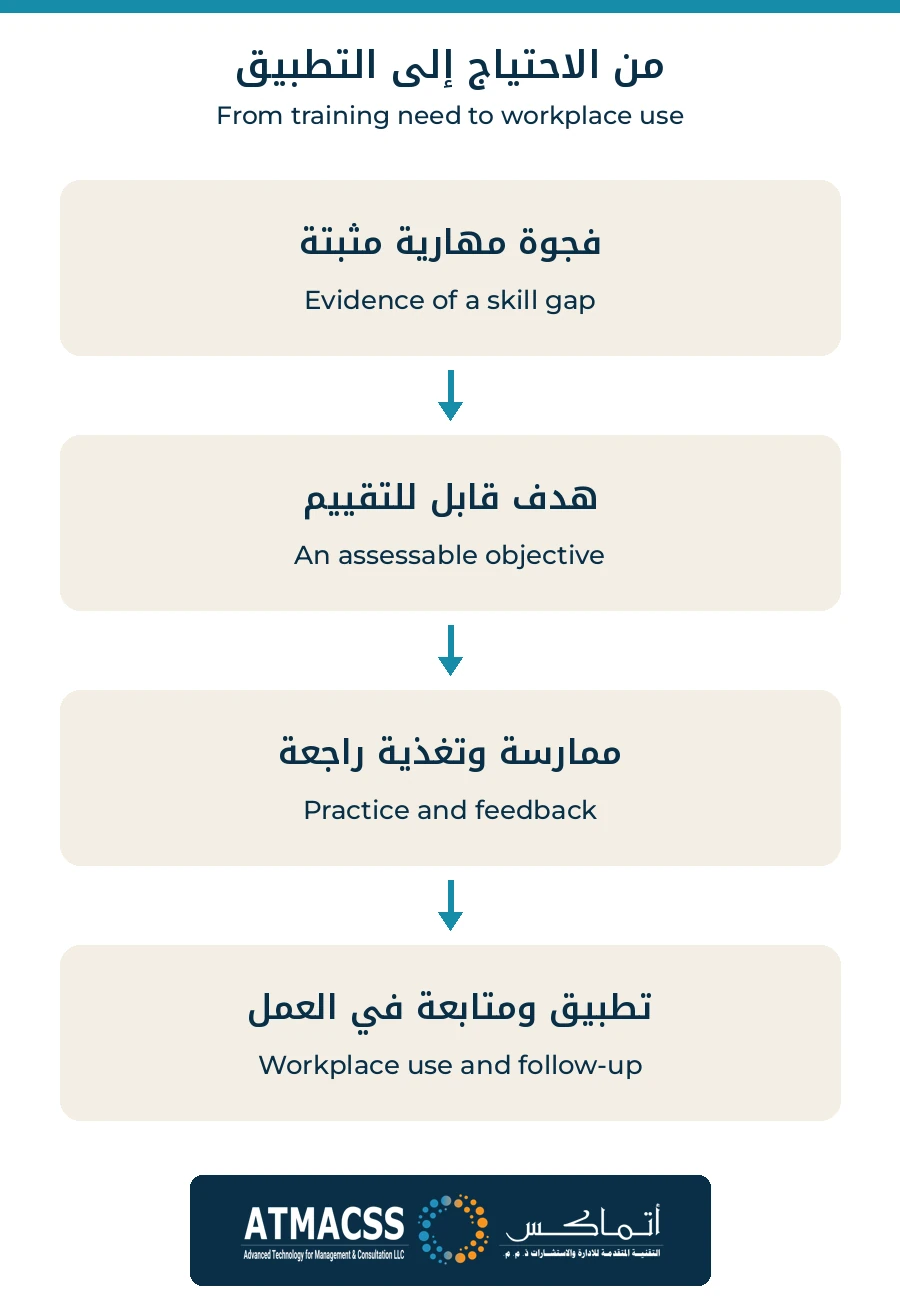
Separate learning, application and business results
- Learning: can the participant complete the assessment task?
- Application: does the person use the skill in actual work when the opportunity arises?
- Business result: did the relevant service or operational measure change?
Participant satisfaction offers useful feedback on the experience, but it does not demonstrate competence. A change in business results also needs context. New software, changed workloads or revised procedures may have contributed. Do not attribute every improvement to the course.
Define passing and remediation before training
Fictional example: In customer-request training, the learner completes a practical case against a checklist. Passing requires every critical step, including authority checks and data protection, plus 80% of the remaining items. This illustrative internal threshold is set by the process owner, not a universal training standard.
Make the scoring rule explicit before delivery. In a fictional checklist with 2 critical steps and 10 other equally weighted items, the learner must complete both critical steps and at least 8 of the other items. Completing all 10 other items cannot compensate for missing a critical step. If the number of items changes, define how the threshold is rounded and tell learners before assessment; do not change it after seeing their scores. Use an equivalent fresh case for reassessment so remembering the previous answer is not mistaken for mastery.
A learner who does not pass receives specific feedback and targeted practice before attempting a different equivalent case. Back at work, a supervisor checks an appropriate sample for skill transfer. A high theory score does not compensate for failing a critical execution step.
Translate the objective into a workable session plan
Prepare one sheet linking each objective to its activity, assessment evidence, timing and materials. If an activity serves no objective, question why it is included. If an objective has no suitable practice, listing it on the opening slide will not be enough. Allow time for learners to attempt the task and correct mistakes, not just listen to the facilitator.
For a fictional 60-minute session, a designer allows 10 minutes for an initial diagnostic and 10 for demonstrating the task. Guided practice takes 20 minutes, an independent attempt takes 15, and planning the next workplace action takes 5. These illustrative timings should be adapted; they are not a recipe for every skill or audience. If the task needs longer, reduce the scope rather than cutting assessment until it becomes meaningless.
Explain prerequisites clearly: what must participants know or bring? Check that they can read the materials and use the available tools. In a multilingual group, use equivalent terminology and understandable examples. When interpreting results, distinguish difficulty with the language from difficulty performing the task.
Pilot the materials and investigate difficulties
Run a small pilot with people who reflect the intended participants. Observe requests for clarification, actual activity timings and agreement between assessors. Different assessments of the same performance may reveal an unclear checklist rather than weak learner performance. Revise instructions and examples, then test the affected part again.
- If most participants miss the same step, review its explanation and the practice provided.
- If the exercise succeeds but workplace application does not, check access, opportunities and manager support.
- If a business result cannot be measured, identify a closer source of evidence without claiming an unproven impact.
Record the materials’ version, date, changes and reasons. Give the facilitator the same checklist and materials that were tested, so passing criteria do not shift during delivery. Set an application review date that reflects how often the task occurs. A monthly skill may not appear in a follow-up conducted only a few days later.
Plan the return to work
Before delivery, agree who will provide feedback and when the skill can be used. After delivery, review a suitable sample of work and discuss obstacles. If participants passed the exercise but cannot apply the skill, inspect the working conditions before repeating the course.
Fictional follow-up: Of 20 participants, only 12 had an opportunity to perform the target task during the review period. Records show that 9 of those 12 applied it correctly: 75% of participants with an opportunity. The remaining 8 are recorded as “not yet observed”, not automatically as successes or failures. Report both the denominator and the 8 pending observations. This small illustrative sample does not establish the whole workforce’s competence or prove that training caused a business improvement.
Agree the observation period, definition of correct performance and sample selection before collecting results. Compare similar tasks and conditions, and record any changes in workload, software or procedures. Use the findings to choose an action: additional practice for a skill gap, process support for an access problem, or another observation when no opportunity has occurred. Review whether that action worked before closing the programme.
Keep a compact programme record: target group, evidence of need, objectives, activities, assessment criteria, support arrangements and revision decisions. This makes the next version easier to improve. For the broader context, see employee development and training and ATMACSS training, coaching and internship support.