



A strategic plan example is useful when it shows how choices, measures and resources connect. Copying another organisation’s targets rarely does that. This article follows a fictional maintenance company through one strategic priority, from the initial choice to a quarterly review. It explains one part of the company’s plan, not its complete strategy. The figures are teaching assumptions, not actual ATMACSS project results or a ready-made plan for every business.
Start with a specific situation
Hypothetical example for illustration. The case and figures below are teaching assumptions, not actual results or industry benchmarks.
The fictional company serves small commercial premises. It has reliable technical capability but loses customers after inconsistent scheduling. Its team cannot expand into every location at once. Interviews and service records suggest that existing customers value dependable appointments more than a wider menu of unrelated services.
That evidence is an assumption for this example. A real company would need to test it with customers, costs and operating data. The plan should state where the evidence is strong and where an unresolved assumption could change the choice. A convincing story does not become a fact merely because it appears in an organised presentation.
Make a choice and state the trade-off
The company chooses to deepen recurring maintenance relationships in its current service area. It postpones a distant branch and unrelated installation services until scheduling becomes dependable. The trade-off matters: without it, the plan would simply list every attractive opportunity without explaining where limited resources will go.
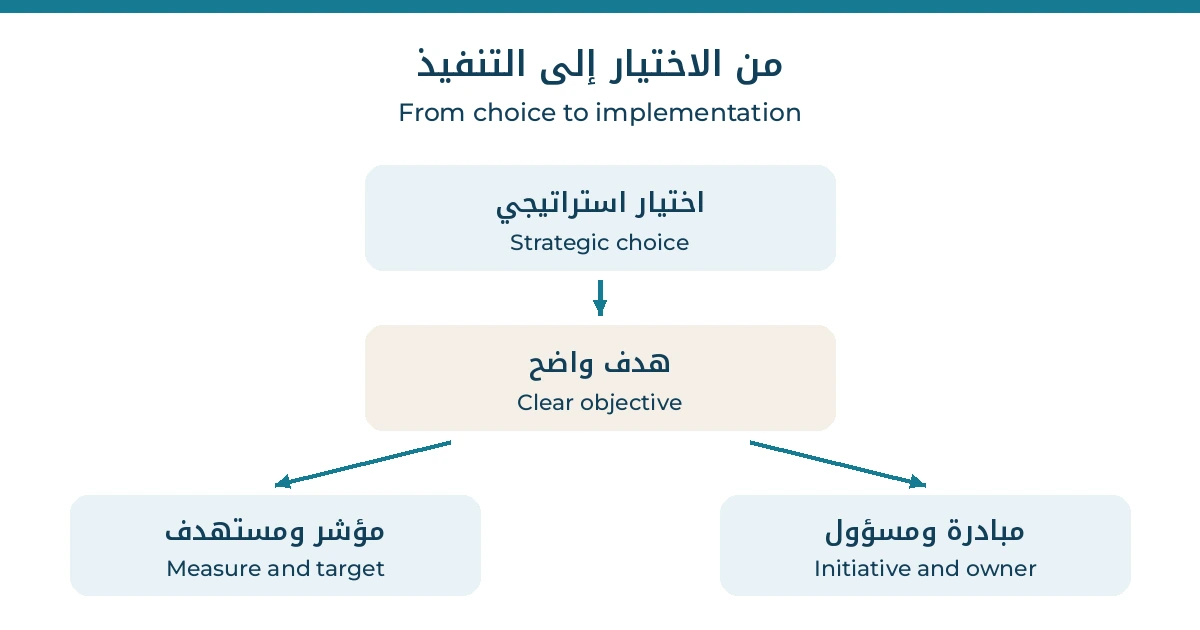
This is a strategic choice about where and how to compete. It is different from the objective, the indicator and the initiative. The objective describes the desired change; the indicator measures progress; the target sets the intended level within a defined period; the initiative is work undertaken to influence the result.
Connect the components
The table turns the choice into commitments that can be tracked. Better scheduling supports customer relationships but does not, by itself, prove recurring contract growth.
| Component | Illustrative plan entry |
|---|---|
| Choice | Focus on recurring maintenance in the current area |
| Objective | Make scheduled service more dependable |
| Indicator | Percentage of visits started within the agreed arrival window |
| Baseline and target | 80% baseline in the previous quarter; 90% target by the end of the second implementation quarter |
| Initiative | Redesign scheduling and customer confirmation |
| Owner | Operations manager |
The target is hypothetical, not an industry benchmark. Before adopting it, a real business would assess customer needs, achievable capacity and the cost of improvement. A numerical target becomes meaningful only when its definition and evidence source are clear. Specify who may change the target when assumptions change.
Specify how the indicator will be calculated
The key performance indicator (KPI) here measures arrival reliability, not completion of the maintenance work. The numerator counts eligible visits started within the agreed arrival window. The denominator counts all eligible visits whose arrival window ended during the period. It includes late and unperformed visits, so failures cannot disappear from the result.
Exclude only customer cancellations documented before the window starts. For customer-requested rescheduling before that point, record the request and count the visit once against its new window. A team update after a missed appointment must not replace the original promise in the record. Retain the agreed window, actual start time and evidence for each exclusion. With no eligible visits, report no data, not a success rate.
In the previous quarter, 80 of 100 visits met the window: (80 ÷ 100) × 100 = 80%. In the first implementation quarter, 108 of 120 did: (108 ÷ 120) × 100 = 90%. This is an improvement of 10 percentage points, not a 10% relative increase. The comparison assumes the same team and counting rules. Reaching the target early does not establish sustained improvement through the second quarter.
Check complaints and repeat visits caused by defective work as balancing measures. Arrival reliability must not improve at the expense of complete work or service quality.
Turn the initiative into owned work
The operations manager tests the scheduling rule in one team during the first 4 weeks, before extending it. The work follows these steps:
- Map how appointments are accepted and assigned.
- Identify the main causes of late arrival using actual records.
- Test a revised scheduling rule in one team.
- Train the people using the rule and confirm customer communication.
- Review results before extending the change.
Assign time, decision authority and any approved spending to these tasks. The example does not assume that new software is necessary. If the main cause is overbooking, buying a scheduling application without changing the booking rule may leave the problem intact.
Protect the ordinary service workload during the test. Name dependencies such as parts availability and access to customer sites. A task owner should be able to explain what is required from another function and when that dependency must be resolved.
Use the quarterly review to decide
At the end of the first quarter, compare the actual result with the target, customer experience and resource use. Ask whether the scheduling rule was used and whether it addressed the cause of lateness. Administrative completion does not necessarily mean better performance or achievement of the strategic choice.
In the example, the rate reaches 90%, but 12 visits miss their arrival window. The operations manager decides to retain the rule and analyse those cases within 2 weeks, documenting their causes. After 4 weeks, the manager reviews the corrective action, complaints, repeat visits and operating cost. The trial is not extended until results are stable and capacity and cost are suitable.
If appointment reliability improves but recurring contracts do not, investigate price, service quality and customer needs. Do not attribute contract growth to scheduling alone without evidence. The initiative may need adjustment while the underlying choice remains appropriate. The second-quarter review is still needed to check whether improvement continues.
Strategy guidance from the National Institute of Standards and Technology (NIST) supports connecting objectives, actions, resources and adaptation. The maintenance company and decision above are an editorial hypothetical example, not a case published by NIST.
Document why the initiative continues or changes
Record the actual indicator against the target, the team’s interpretation and supporting evidence. Separate a scheduling adjustment from a change to the strategic objective. The initiative may need repair while the underlying choice remains suitable. If the definition or eligible cases change, explain their effect before comparing percentages.
Retain the previous plan version, the reason for the change and the authorised decision-maker. Specify what the next review will examine. Updating the presentation must not erase an assumption that proved wrong. Delaying a decision is not unconditional approval to continue.
Adapt the logic rather than copying the numbers
A startup may need to test demand before setting a scale target. A public-service team may focus on access and service outcomes rather than recurring contracts. A manufacturer may need different capacity and quality measures. Keep the connection between choice and execution, but change the measures and constraints to fit the organisation.
For your next step, write one row connecting a strategic choice, objective, measure, initiative and owner. Compare it with the components of a strategic plan and discuss it with the people who will deliver it.
Conclusion
The example’s value lies in its connections, not its target number. Begin with a choice that defines what to pursue and postpone. Link the objective to a clear measure, an owned initiative and resources. Use reviews to turn results into documented decisions. Apply this logic to one priority, adapting the evidence, measures and constraints to your organisation.