



The value of an ISO management system should be assessed through changes in how the organisation works, not the presence of a certificate alone. This article shows how to define an intended benefit, compare evidence before and after implementation and account for the costs. A fictional rework example illustrates the method without presenting a guaranteed return.
Separate the system from certification
A management system coordinates responsibilities, processes and review so an organisation can pursue its objectives consistently. Certification is an independent assessment against specified requirements. The two are related, but a certificate is not itself the operational improvement. A certified organisation may still need to resolve recurring delivery or coordination problems.
ISO explains that organisations can benefit from implementing management system standards without certification. A customer contract or sector requirement may nevertheless make certification relevant. Establish why it is being sought and check the specific obligation rather than assuming every business needs the same certificate.
For illustration, a quality system might target less rework or more reliable delivery dates. An environmental system might target lower material use per comparable unit of output while also monitoring total consumption. In occupational health and safety, track implementation and effectiveness of hazard controls alongside incident outcomes. An absence of recorded incidents alone does not demonstrate safe working conditions.
A certificate required by a contract may help satisfy a customer’s qualification condition, but it does not guarantee the award. These are examples of intended benefits, not automatic results for every organisation. Select what relates to your problem and system scope, then turn it into a specific claim that evidence can test.
Turn a promised benefit into a testable statement
Replace “better efficiency” with a defined operational problem. For example: reduce avoidable rework caused by incomplete order specifications. Identify the process owner, the current definition of rework, the relevant order population and the source of the records. Another person should be able to apply the inclusion and exclusion rules without guessing.
Distinguish outputs from outcomes. Issuing a procedure is an output. More complete order information is an intermediate result. Fewer avoidable corrections is an operational outcome. Customer retention may depend on many additional factors, so it should not be attributed to the procedure without further evidence.
Create a fair baseline
A baseline is a documented starting point for comparison. Choose a period that represents the work you want to improve. Record workload, case complexity and unusual conditions. Keep the definitions consistent between periods; a falling count can hide a rising error rate if activity has fallen faster.
Where earlier records are unreliable, establish a prospective baseline rather than inventing one. Note missing data and explain how it limits the conclusion. You may start with a smaller process where the records are dependable and expand measurement once definitions and recording practices are stable.
Worked example: rework per completed order
For this exercise, rework means correcting completed work because it did not meet the agreed order requirements; a newly requested customer change is recorded separately. Count each affected order once in the numerator, even if it needed several corrections. Keep the number of corrections and the hours spent as separate measures so repeated or difficult problems remain visible.
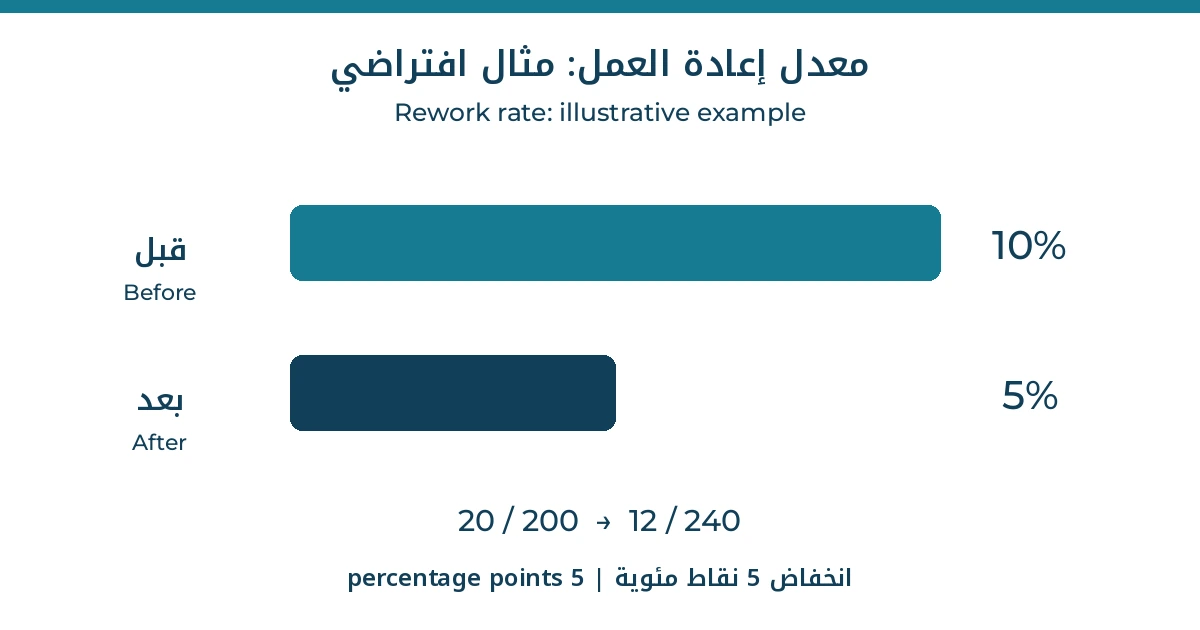
A fictional company records 20 orders requiring rework among 200 completed orders before a change. After introducing a clearer requirements check, it records 12 among 240 orders. The rework rate moves from 10% to 5%: a reduction of 5 percentage points, or 50% relative to the original rate. These are illustrative figures, not a forecast or an ATMACSS client result.
| Measure | Before | After |
|---|---|---|
| Completed orders | 200 | 240 |
| Orders requiring rework | 20 | 12 |
| Rework rate | 10% | 5% |
Use two equal completion periods and give every order the same follow-up window. For example, allow 30 days after completion to record rework against each order, then compare the two groups after both windows have closed. The 30-day choice is illustrative, not an ISO rule; use a period suited to how problems emerge in your service. Orders with incomplete follow-up remain pending, not automatically free of rework.
The comparison is encouraging, but it does not prove the management system caused the entire change. Check whether the later orders were simpler, staff changed or another improvement occurred. Review more than one period and inspect the types of rework that remain.
Calculate costs without double counting
Record implementation effort, training time, tools, audit fees where applicable and the recurring work needed to maintain the system. Internal staff time is a real resource even when it does not appear as a new invoice. Separate one-off expenditure from continuing cost.
If the team saves 30 hours, decide whether those hours reduce paid overtime, create usable capacity or merely move waiting time elsewhere. Do not book the same benefit as both a cash saving and additional productive capacity. A financial estimate needs an explicit assumption about how the released resource will be used.
Consider a separate illustrative time calculation: 30 hours of rework avoided in a month, but 6 extra hours spent on the new requirements check in that same month. The net time released is 30 − 6 = 24 hours, assuming no other time changes. If salaries and paid overtime remain unchanged, this is available capacity rather than demonstrated cash savings. Record how that capacity was actually used before claiming an additional business benefit.
Use the same period and scope for benefits and costs. Avoid comparing a full-year projected benefit with only the first month’s cost. If the evidence is too weak for a financial return calculation, report operational measures and the uncertainty instead of manufacturing precision.
Check what certification does not establish
- It does not guarantee zero defects, incidents or complaints.
- It does not automatically establish compliance with every applicable law.
- It does not prove that every product or location lies within the certified scope.
- It does not guarantee new contracts or improved profitability.
Management still needs to identify obligations, operate controls and investigate failures. Claims about the system should match the certificate’s scope and the evidence available. Avoid displaying a certification mark in a way that suggests unrelated products have been independently certified or that ISO itself issued the certificate.
Document realised benefits and prevent double counting
Keep a concise record connecting the problem, control, observed change and evidence source. The process owner should review the explanation, with finance involved when the result becomes a cash-saving claim. Record assumptions that remain unverified instead of treating the entire projected benefit as realised.
In the rework example, check that corrections have not moved into after-sales support or to a supplier without appearing in the original record. If training and a system change jointly contributed, neither project should independently claim the full value. Review whether the outcome persists after temporary support ends and assign responsibility for maintaining the control. This keeps the benefit connected to actual operations rather than a number repeated without verification.
Build a benefit review into normal management
Assign each intended benefit an owner, measure, evidence source and review date. At review, record the observed change, the likely explanation and the next action. A disappointing result may indicate that the chosen control addresses the wrong cause or that implementation has not reached the people doing the work, or that the observation period is too short for a stable conclusion.
Start with one material problem and one reliable measure. Use the ROI article only where the financial assumptions are defensible, and review certification readiness separately. ATMACSS ISO implementation support can help connect system requirements with operating responsibilities and evidence of improvement.