



ISO 26000 provides guidance on social responsibility. It helps organizations examine how their decisions and activities affect people, society and the environment. It is not a certification standard. This article explains that boundary, introduces the main subjects and shows how to turn a broad commitment into specific actions, responsibilities and evidence that can be reviewed.
What does ISO 26000 cover?
Social responsibility concerns how an organization takes responsibility for the impacts of its decisions and activities. Donations can form part of its contribution, but they do not replace responsible purchasing, fair treatment or honest communication. Begin with what the organization does every day and who is affected by that work.
ISO 26000:2010 is guidance for different kinds and sizes of organizations. It does not provide a set of certifiable management-system requirements. ISO explicitly explains that ISO 26000 cannot be used for certification. A training certificate, external assessment or consultancy report must not be presented as an ISO 26000 certificate for the organization.
Principles and subjects are different
The principles concern how an organization behaves: accountability, transparency, ethical behaviour, respect for stakeholder interests, the rule of law, international norms of behaviour and human rights. The core subjects identify areas to examine. Keeping these two ideas separate helps prevent a list of values from being mistaken for evidence of implementation.
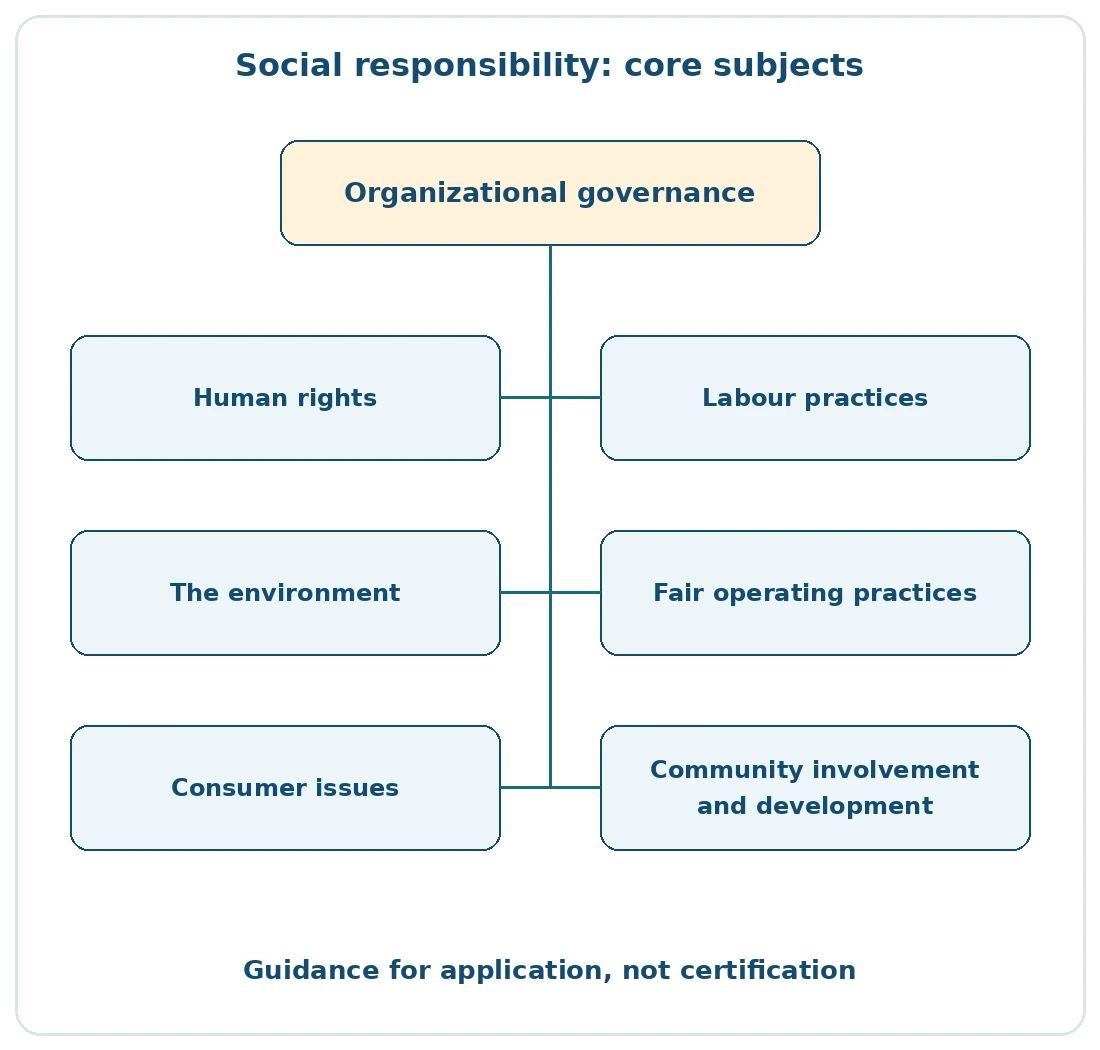
ISO’s introductory brochure identifies seven core subjects: organizational governance, human rights, labour practices, the environment, fair operating practices, consumer issues, and community involvement and development. Review all seven before prioritizing specific issues. A campaign focused on one attractive subject does not demonstrate that other significant impacts have been addressed.
Start with activities and affected people
Write down the activities within scope, including products, services, locations and important business relationships. Ask who may experience their effects. Employees, customers, suppliers and neighbouring communities may see different problems. Do not identify stakeholders only by their ability to influence a sale or attract publicity. People affected by a decision may have limited ability to make their concerns heard.
Build a simple issue record. State the activity, potential or observed impact, affected group, evidence available and the responsible person. For example, a delivery operation might examine avoidable packaging waste, access to complaint channels and the reliability of customer information. These are prompts for investigation, not a claim that every delivery business has the same impacts.
Gather evidence from complaints, operating records, purchasing practices and conversations with affected groups. Record where the information came from and what it cannot establish. A survey with few responses should not be treated as the voice of an entire community. Explain how views were collected and which groups still need a way to participate.

Choose priorities transparently
Use a consistent discussion of significance rather than selecting only inexpensive or visible projects. Consider the nature and severity of the impact, who is affected, the organization’s connection to it, applicable obligations and the possibility of changing the outcome. Serious adverse impacts deserve attention even when they are uncomfortable to discuss or difficult to measure.
Document why an issue is prioritized and why another is deferred. Name the decision owner and the trigger for review. If evidence is incomplete, define the investigation required. A priority list should not become a permanent excuse to ignore unresolved concerns. Revisit it when the business changes, new evidence appears or stakeholders raise a material issue.
Translate commitments into work
For each selected issue, define an action, owner, resources, due date and evidence of completion. Distinguish producing a policy from changing practice. A supplier code is a document; evidence that purchasing staff use it when evaluating a supplier is a different result. Both may be needed, but one cannot substitute for the other.
| Illustrative issue | Practical action | Evidence to review |
|---|---|---|
| Customers cannot find a complaint route | Provide an accessible route and assign case ownership | Case records, response quality and unresolved themes |
| Packaging is routinely discarded | Test a return or reuse arrangement within a defined scope | Returned quantities, losses and actual operating costs |
| Supplier expectations are unclear | Clarify purchasing criteria and staff responsibilities | Procurement decisions and follow-up on identified gaps |
These examples are editorial suggestions, not a universal ISO checklist. Tailor the actions to the evidence and responsibilities of your organization. Integrate them with existing operating procedures, budgets and management reviews so they remain part of normal work. Creating a separate presentation without changing ownership or resources will rarely resolve an operational issue.
Measure change without overstating it
Define each measure before collecting results. Record its scope, unit, source, baseline, reporting period and owner. If packaging returns are measured, specify which products and locations are included. If complaint handling is measured, examine the quality of resolution as well as response time. A fast closure can hide an unresolved problem.
Compare like with like. A reduction in total waste could result from lower production rather than a better process. Where useful, review both totals and an appropriate activity-based measure. Explain data gaps and changes in boundaries. Use the KPI design article to connect measures to objectives and targets.
Illustrative example: a distribution centre records 1000 kg of packaging waste for 10000 orders in the baseline period, then 900 kg for 7500 orders in a comparable period. Total waste falls by 10%, but waste per order rises from 1000 ÷ 10000 = 0.10 kg to 900 ÷ 7500 = 0.12 kg, an increase of 20%. A lower total alone therefore does not demonstrate improved packaging efficiency. Check changes in order mix, materials and recording methods before assigning a cause.
If the internal target in this example is no more than 0.09 kg per order, the actual 0.12 kg exceeds it by 0.03 kg per order. The operations owner verifies the data, tests a defined change and measures again while monitoring product damage and operating cost. Reducing packaging in a way that increases damage can shift the harm rather than resolve it. These are educational figures for a defined centre and period, not ATMACSS results or evidence of improved overall environmental impact.
Communicate specific actions and limitations
Describe what was done, the period covered, the evidence used and what remains incomplete. Avoid broad claims such as being fully sustainable when only one practice has been reviewed. Do not imply that using ISO 26000 proves legal compliance, eliminates harm or qualifies the organization for an award. Each of those claims requires its own evidence and applicable criteria.
Where an external party reviews the work, identify the scope and nature of that review accurately. A limited assessment does not cover activities outside its scope. Keep supporting records available and correct inaccurate public statements. Responsible communication should allow readers to understand both progress and the work that has not yet been completed.
How can ATMACSS support the next step?
Start with one documented review of activities, stakeholders and significant issues. ATMACSS can discuss support for connecting those findings to governance, objectives and implementation through ISO implementation consulting and strategic planning and KPIs. For ISO 26000, the engagement concerns guidance and application, not certification.
Prepare existing policies, operational evidence and stakeholder concerns before the discussion. Contact ATMACSS to define the scope, expected outputs and review responsibilities. The useful result is a clear set of actions integrated into management, with evidence that can be checked and improved over time.