



Calculating project return on investment starts with deciding what the calculation includes. A percentage becomes misleading when sales are treated as profit, costs are omitted or different periods are compared. This worked example shows how to build a simple, undiscounted project calculation, test its assumptions and decide which questions still need a fuller financial appraisal.
Define the calculation before collecting numbers
Return on investment (ROI) expresses net benefit relative to a defined investment cost. For this example, simple project ROI equals total incremental benefits minus total incremental costs, divided by total incremental costs, multiplied by 100. State the definition beside the result because organisations use different ROI conventions. “Undiscounted” means amounts are combined without adjusting their value for when they are paid or received.
Use one currency and one review period. Identify the alternative: continuing the current process, buying another solution or postponing the project. Benefits are changes against that alternative, not all revenue earned after implementation. The ROI overview explains the broader concept; here the focus is checking a specific calculation.
Build a cost list that can be checked
Include implementation, integration, training, support and additional operating costs relevant to the chosen period. Record each amount, its source, payment date and whether it is an estimate or an actual payment. Avoid counting the same supplier charge under both implementation and software.
For a forward-looking cash decision, ACCA explains that relevant cash flows are future and incremental. Money already irreversibly spent is a sunk cost. Keep that historical expenditure visible in a whole-project review, but do not pretend it can be avoided when comparing the options still available. Explain which decision your calculation addresses.
Work through a 12-month example
Consider a hypothetical invoice-processing project for illustration. Figures are in AED and cover one 12-month period beginning with setup, including its cost. Assume the stated benefits arise within that same period, rather than an additional year after implementation. The example excludes tax, financing and discounting so that the arithmetic can be checked directly.
| Item | Amount |
|---|---|
| Setup and integration | 20,000 |
| Training | 5,000 |
| Additional annual support | 5,000 |
| Total incremental cost | 30,000 |
| Reduction in paid overtime assumed for this example | 24,000 |
| External processing fees assumed to be avoided | 18,000 |
| Total incremental benefit | 42,000 |
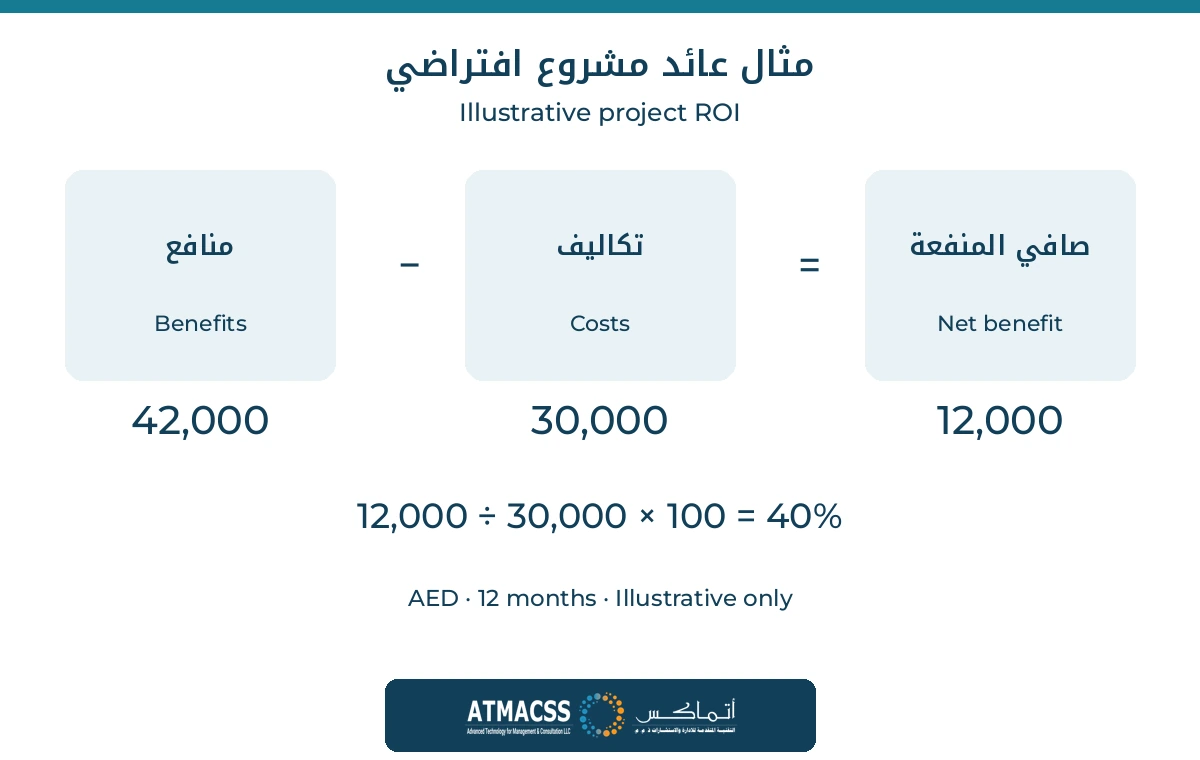
Net benefit is 42,000 − 30,000 = 12,000. Simple ROI is 12,000 ÷ 30,000 × 100 = 40%. This means the defined benefit exceeds the defined cost by 40% over the stated period. It does not mean every project will achieve that return.
Check whether a benefit is really cash
Time released is useful capacity, but it is not automatically a reduction in expenditure. If salaries remain unchanged, report hours released separately unless paid overtime or hiring that would otherwise occur is demonstrably avoided. Using released time for additional profitable work is a different benefit, not an expense reduction. Calculate its incremental cash effect after associated costs, and do not count the same hours twice under different benefits.
For the example, retain payroll evidence for overtime and supplier invoices for processing fees. Check that lower activity, delayed invoices or another project did not cause the reduction. Assign an owner to each benefit and document assumptions about adoption and transaction volume. Estimates should remain labelled as forecasts until supported by actual results.
Test the assumption that matters most
Sensitivity analysis tests how the result changes when an assumption changes. Suppose only 30,000 of benefit is achieved while cost remains 30,000. Net benefit and ROI are both zero. If benefit falls to 24,000, net benefit becomes −6,000 and ROI becomes −20%. These are hypothetical scenarios; no probability has been assigned to any of them. They show how sensitive the decision is to benefit delivery.
Also test delayed implementation, higher support costs and lower usage. Change one assumption at a time to understand its effect, then examine a combined downside case. A project with a positive forecast can still create a cash shortage if its costs are paid before benefits arrive.
Review actual results on the same comparison basis
Extend the educational example by assuming actual year-end cost is AED 33,000 rather than 30,000. Paid overtime falls by 21,000 and avoided external fees total 15,000, giving benefits of 36,000. Net benefit becomes 3,000 and ROI is approximately 9.1%: 3,000 divided by 33,000, multiplied by 100. Do not combine planned cost in the denominator with actual benefits and label that the actual return.
Explain the variance before judging the project manager. Cost might have increased because of approved extra integration, while benefits might have fallen because adoption started late. Check invoices, the change record, the operating start date and transaction volumes. Do not assume these causes without evidence. Separate price changes from quantity changes, then identify what can be addressed, such as user training or a transaction workflow error.
Retain the original budget, revised forecast and actual outcome as distinct values. Do not erase the original assumption to make the plan match reality. If fewer than 12 months have elapsed, identify the completed months and label the rest as forecast. Do not extend one busy month’s savings across a year without checking seasonality and stable operation. Report non-cash benefits, such as fewer errors, in appropriate units rather than automatically adding them to the financial total.
Before approving the calculation, match each amount to its evidence and period, and check that one saving is not counted under different labels. Document excluded items and reasons, including tax and financing in this simplified example. If the cost denominator is zero, this formula cannot calculate the percentage. Do not display zero or an infinite return. Cash availability, alternatives and risks still matter to the decision.
Use the result with its limits
Simple ROI does not account for the timing of money within the period, uncertainty or all non-financial effects. Multi-year investments may require discounted cash-flow (DCF) appraisal. This converts future cash flows into present values using an appropriate discount rate, reflecting when money becomes available. Tax and financing need consistent treatment appropriate to the decision. Also consider the asset’s value at the end of the appraisal period. Include the benefit forgone by using a resource for this project instead of its best available alternative: its opportunity cost. Do not compare this simple calculation directly with a differently defined accounting return.
The example produces a simple ROI of 40% within its stated costs, benefits and period. A reliable result depends on sound inputs, testing changes to them and comparing expectations with what actually happens. A positive percentage alone does not prove that this is the best option or that cash will be available when needed.
Before approval, ask a finance reviewer to check the assumptions and obtain evidence for the largest uncertain benefit. Start with a small test if that evidence is missing. ATMACSS business and operations modelling can help map process changes and their operational consequences before financial approval.