



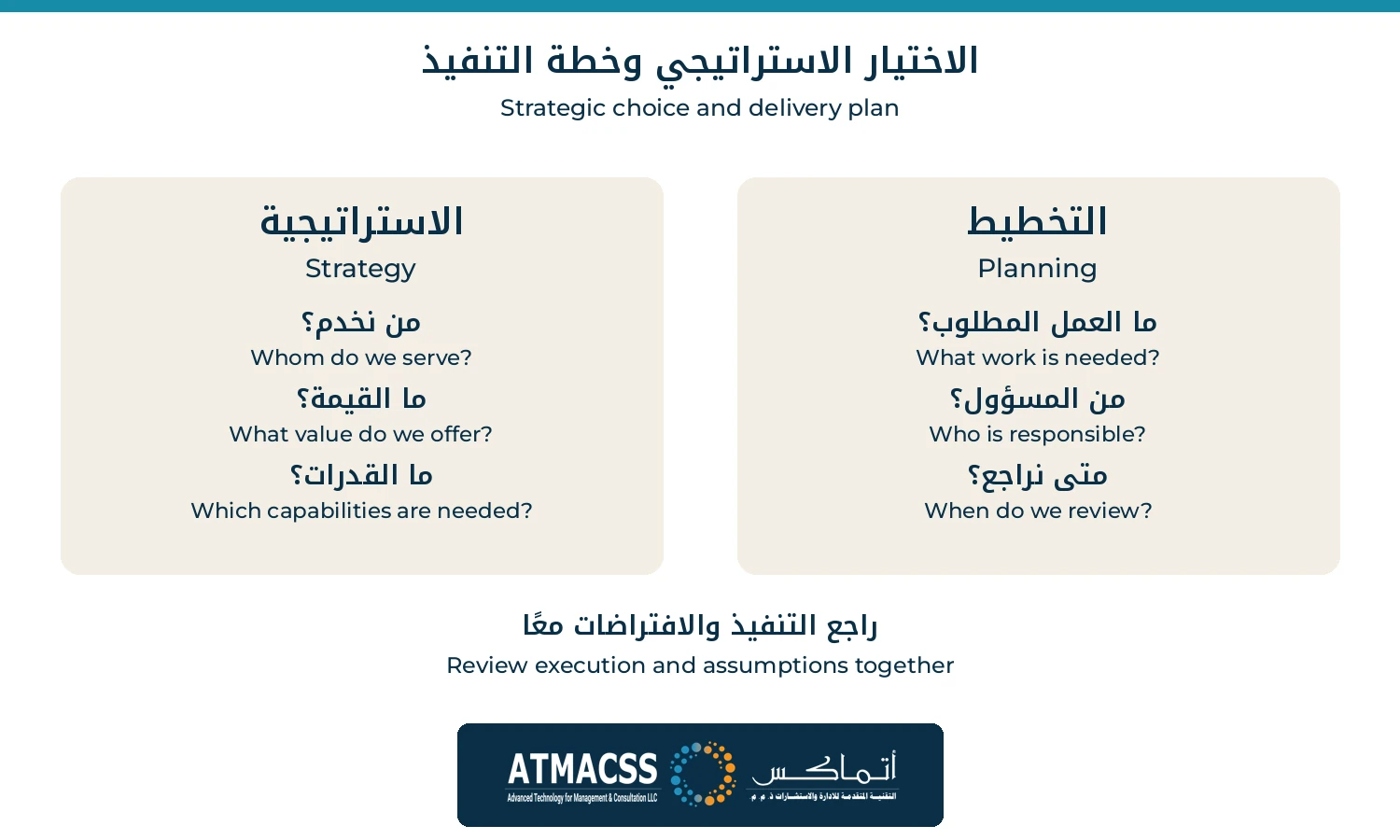
Strategy and planning are connected, but they answer different questions. Strategy sets out the choices behind how a business intends to succeed. Planning organises the work and resources needed to act on those choices. This article uses a practical example to distinguish both and prevent a busy activity plan from being mistaken for a coherent strategy.
Define the two concepts
A business strategy is a coherent set of choices about the customers or needs to serve, the value to offer and the capabilities required. It includes trade-offs: choosing one approach can mean declining another. It also contains assumptions about customers, competitors and the operating environment that may prove wrong.
Planning is the process of arranging actions, resources, responsibilities and timing to pursue objectives. A business plan can contain the strategy as well as market analysis, operations and financial projections. The distinction is not simply “strategy is long-term and planning is short-term”. Both can address different time horizons, and both require revision when evidence changes.
Strategic planning is a structured process for examining the situation and options, setting direction and objectives, and connecting them with resources, initiatives and review arrangements. It can help formulate and update strategy, but completing a template or schedule does not establish the quality of the choices. The discussion begins with “Why choose these customers and this value?” and then turns to “How will we implement the choice and test whether it makes sense?”
One business, two sets of questions
Consider a fictional maintenance company deciding to serve small commercial buildings that need reliable scheduled support. Its strategic choice is to compete through predictable preventive service in a limited area. That choice requires suitable technical capability and dependable scheduling. It may decline distant assignments that would undermine the service promise.
The delivery plan then specifies how to test the offer, train staff, arrange scheduling and review initial contracts. It names owners, resources and review dates. Buying scheduling software is an activity within that plan. It is not, by itself, the strategy.
If customers mainly need emergency coverage and will not value the proposed offer, finishing the software project on time will not solve the strategic problem. The organisation must revisit the underlying choice, not simply add more activities.
Keep the management terms distinct
- Objective
- The result the organisation wants to achieve.
- Indicator
- A measure used to assess progress or performance.
- Target
- The intended level of that measure within a defined period.
- Initiative
- A coordinated piece of work intended to contribute to the objective.
- Decision
- A choice about what to do, continue, change or stop.
For the fictional company, dependable service is the intended result. The proportion of visits completed within the agreed window could be an indicator. The organisation would set an appropriate target from evidence and capacity. A scheduling improvement is an initiative. These terms describe different parts of the same management system.
Fictional measurement example: During a month, 40 visits were due and 36 were completed within the agreed time window, giving an on-time rate of 90%. If the approved target is 95%, the gap is 5 percentage points. With the total held at 40 visits, meeting the target requires 38 on-time visits. This is an illustrative target, not a general maintenance-industry benchmark. When management selects this measure to track a key objective, it becomes a key performance indicator (KPI), interpreted against the specified target and period.
Define the denominator in advance: all visits due during the period under stated rules, including late or uncompleted visits, rather than completed visits alone. Document cancellations and rescheduling with their reasons; do not move deadlines retrospectively to improve the percentage. If delays relate to missing spare parts, the response may concern stock or suppliers rather than another software purchase. Even achieving 95% does not, by itself, establish strategic success: customer value and the economics of the service also need review.
Hold two kinds of review
- Execution review: are agreed actions being completed, and what blocks delivery?
- Strategic review: do customers value the offer, and do the assumptions still support the chosen approach?
Use execution information to expose problems, but do not assume that completing every task proves the strategy is sound. Equally, do not change the strategy whenever one task is late. Investigate whether the issue concerns delivery, the underlying choices or both.
Test whether the choices fit together
The Harvard Business School Institute for Strategy and Competitiveness connects strategy with distinctive value, trade-offs and fit between activities. In the maintenance-company example, check whether service area, staffing, scheduling and pricing support dependable preventive service. Accepting distant contracts without additional capacity may contradict that choice even if revenue increases. Record why an opportunity is accepted or declined instead of assuming every growth opportunity fits.
Write a strategic choice card
For the maintenance company, a short card can identify the target customer, need, promise, required capability and services the company will not offer. Record the assumption that could change the decision if it proves wrong. This card is an editorial working suggestion, not a mandatory template issued by the cited organisations.
One assumption might be that building owners prefer scheduled preventive visits at a predictable price. Evidence from customers, contracts and operations is needed. The team agreeing on the wording of a promise is insufficient. Ask how customers currently choose, which problem they would pay to solve and what prevents them from trying the offer.
Next, examine the capability that makes the promise feasible. If reliability depends on disciplined scheduling and available spare parts, staffing, stock and work allocation need to support it. Strategy should not become a marketing message detached from daily work. Consistency appears in repeated decisions, especially when a new sales opportunity conflicts with delivery capacity.
Give each initiative a review question
Alongside the scheduling initiative, specify the desired result and the evidence needed to assess it. Buying software or training staff is not the end of the work. Check whether visits became more dependable and whether waiting or coordination effort changed. Keep the measurement definition consistent and explain changes in contract mix or demand.
If the initiative is complete but service has not improved, first examine execution: was the system used as planned, and did information arrive on time? Then examine the assumptions: was scheduling actually the cause of the problem? Changing implementation differs from changing the target customer or service promise. Each needs evidence and a decision proportionate to its effect.
Set a resource limit and review period before adding further initiatives. The company may need to stop a lower-priority activity to create capacity for its chosen approach. Record the consequence and decision owner. A plan containing every wish without identifying what will wait does not resolve limited resources.
When evidence changes, update the choice and its connected plan together. Explain what changes, what continues and why. Retain the earlier assumption and its outcome for learning instead of rewriting the document to make every past decision appear correct. This record helps explain the strategy’s development and review the quality of later choices.
Create a short connected record
Write the strategic choices and key assumptions first. Beneath them, list the initiatives that test or implement those choices. Assign owners and evidence for review. Remove activities that have no clear connection, or explain why a mandatory operational task must still be done.
A plan is useful when it helps people act and learn, not because it contains many pages. For implementation detail, see connecting strategy to operations and ATMACSS strategic planning and KPI support.