



The best accounting system for a business in the UAE is the one that supports its transactions, controls and reporting requirements with a manageable operating cost. A product demonstration alone cannot establish that fit. Start with the work your finance team must perform, then test shortlisted systems against the same realistic scenarios.
An accounting system is more than software
An accounting system combines people, procedures, records and technology to record, classify and report financial transactions. Software supports that system; it does not decide whether an expense is legitimate, an approval is valid or a balance is correct. Those responsibilities remain with the business.
For example, invoice capture can reduce retyping, but somebody still needs to confirm the supplier, purchase and accounting treatment. A useful selection process therefore examines controls and responsibilities alongside automation.
Separate deployment from functional scope
Cloud and on-premises describe deployment arrangements. Standalone accounting and an accounting module within enterprise resource planning (ERP) describe functional scope. These are overlapping dimensions: an ERP platform can be cloud based. Treating them as four mutually exclusive accounting systems makes comparisons misleading.
A small service business may need reliable invoicing, expenses and bank reconciliation. A distributor may also need inventory valuation, purchasing and warehouse integration. Group companies may require multiple entities and consolidation. More features are useful only when the business can operate and control them.
Build a requirements brief before the shortlist
- Transactions: document sales, purchases, refunds, currencies and recurring entries.
- Structure: list entities, branches, departments and reporting periods.
- Controls: identify approval limits, segregation of duties, audit trails and period locks.
- Connections: describe the information exchanged with payroll, banking, inventory and customer systems.
- Operations: specify support hours, user access, backup arrangements and data export needs.
Distinguish mandatory requirements from preferences. Ask the responsible finance professional to validate accounting and tax requirements for the actual entity. A vendor’s general claim of “UAE compliance” is not evidence that every applicable obligation is configured correctly.
For electronic invoicing, consult the UAE Ministry of Finance’s current programme and provider information. Ask what the offered product does, what depends on another service provider, and who maintains integrations. Do not assume an ordinary PDF invoice establishes compatibility with an electronic invoicing framework.
Make the demonstration an acceptance test
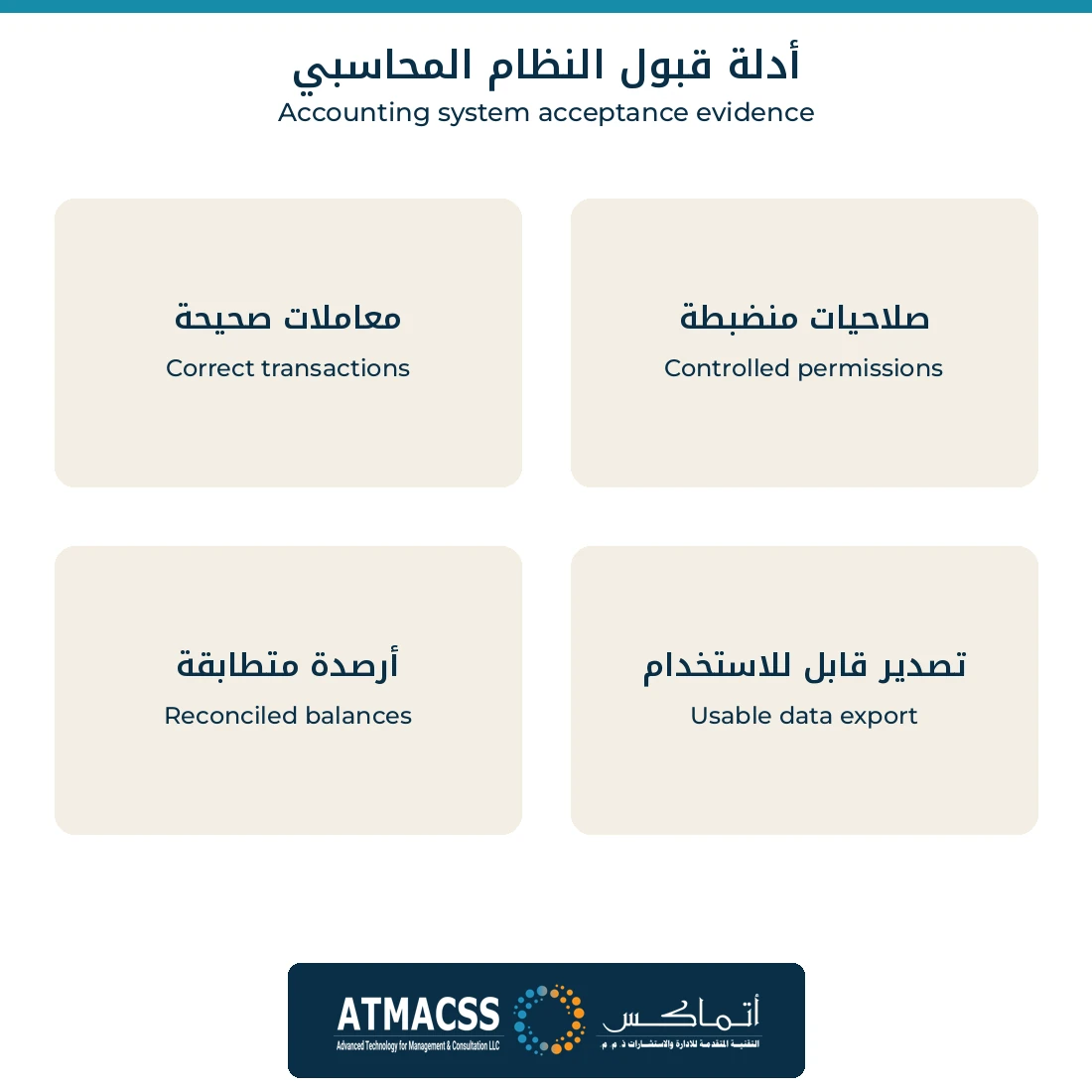
| Scenario | Evidence to request |
|---|---|
| Invoice, credit note and receipt | Correct linked entries and traceable adjustments |
| Purchase approval and payment | Permissions prevent an unauthorized user completing every step |
| Bank reconciliation | Differences are visible and can be investigated |
| Period close | Reports reconcile and later changes leave an audit trail |
| Exit from the product | Usable export of records and supporting attachments |
A demonstration supports shortlisting; it does not replace user acceptance testing (UAT) on the configured system and its agreed interfaces. For each test, record the requirement, sample inputs, expected result, actual result and evidence. The finance owner approves the outcome; a vendor marking its own checklist is not sufficient. Retest affected scenarios after a correction, including both permitted and prohibited actions.
Use anonymized sample data. Record whether a requirement works in the standard product, requires configuration, needs customization or remains unavailable. Ask who will maintain every customization after an upgrade.
Compare the full cost and delivery risk
Include subscriptions, implementation, data cleansing, migration, interfaces, training, support and internal staff time. Confirm how charges change with users, entities, storage or transaction volumes. Compare costs over the same planning period, using assumptions that each supplier can challenge.
Assess access security, administrative privileges, recovery arrangements and supplier incident communication. Backup availability is not enough: the business needs a workable recovery process. Establish who owns the records, where relevant contractual responsibilities sit and how data can be recovered when the relationship ends.
A worked acceptance and reconciliation example
Fictional example: The business migrates 3 customer balances of AED 12,000, AED 8,000 and AED 5,000. The receivables total must equal AED 25,000 before and after migration. Finance reconciles customer balances and open invoices to the control account and explains differences before approval. Matching the total is insufficient if an invoice belongs to the wrong customer.
Use the same cutover date, currency and transaction scope in both systems. Reconcile invoice references, customer allocation, due dates, unapplied receipts and credit notes, as applicable. Agree how open invoices and the general-ledger opening balance interact: importing both must not post the same receivable twice. Repeat the migration rehearsal to confirm that rerunning it does not duplicate transactions. Record each difference, its cause, correction and finance approval.
Next, an unauthorised user attempts to approve their own payment. If the system permits this against the agreed mandatory control, acceptance fails even if the product scores 90 out of 100 overall. Record the defect, retest the fix and withhold go-live approval while a critical defect remains open. These are internal-control examples, not a complete accounting requirements checklist.
Keep evidence of retesting after corrections
When an acceptance scenario fails, record the inputs, expected and actual results, and system version tested. After correction, repeat the scenario and check connected functions: an entry may be correct while a related permission or reconciliation fails. Preserve the original failure and explain its resolution so finance can understand the later acceptance decision.
Maintain the open-defect list, each defect’s impact and decision owner. Distinguish a go-live blocker from an improvement that may be scheduled later under an approved assessment. Test with the actual user’s assigned permissions, not only an administrator account. Approval should rest on operating and control evidence, rather than the project deadline or a successful vendor demonstration.
Plan the transition with finance in control
- Assign a finance owner and agree acceptance criteria.
- Clean and map master data and opening balances.
- Rehearse migration and reconcile the results.
- Train users on their actual tasks and approval limits.
- Approve cutover only after critical issues are resolved.
- Review the first reporting close and stabilize support.
Test an interrupted interface as well as a successful transfer. If a bank receipt or invoice is sent again after a timeout, verify that it is posted once, that its status is visible and that failed items can be reconciled and resolved. Name who monitors exceptions and how quickly they must act. A successful connection alone does not establish that the financial records remain complete and accurate.
Define a contingency for a failed migration or unavailable system before switching. Retain access to historical records in a usable form. The implementation team should demonstrate reconciliations; management should not accept a dashboard as a substitute for them.
An independent consultant can help structure requirements, compare evidence and coordinate implementation. Ask about commissions or supplier relationships. Begin with a documented transaction sample and unresolved reporting problems, then discuss process requirements through business and operation modelling.